Key Highlights
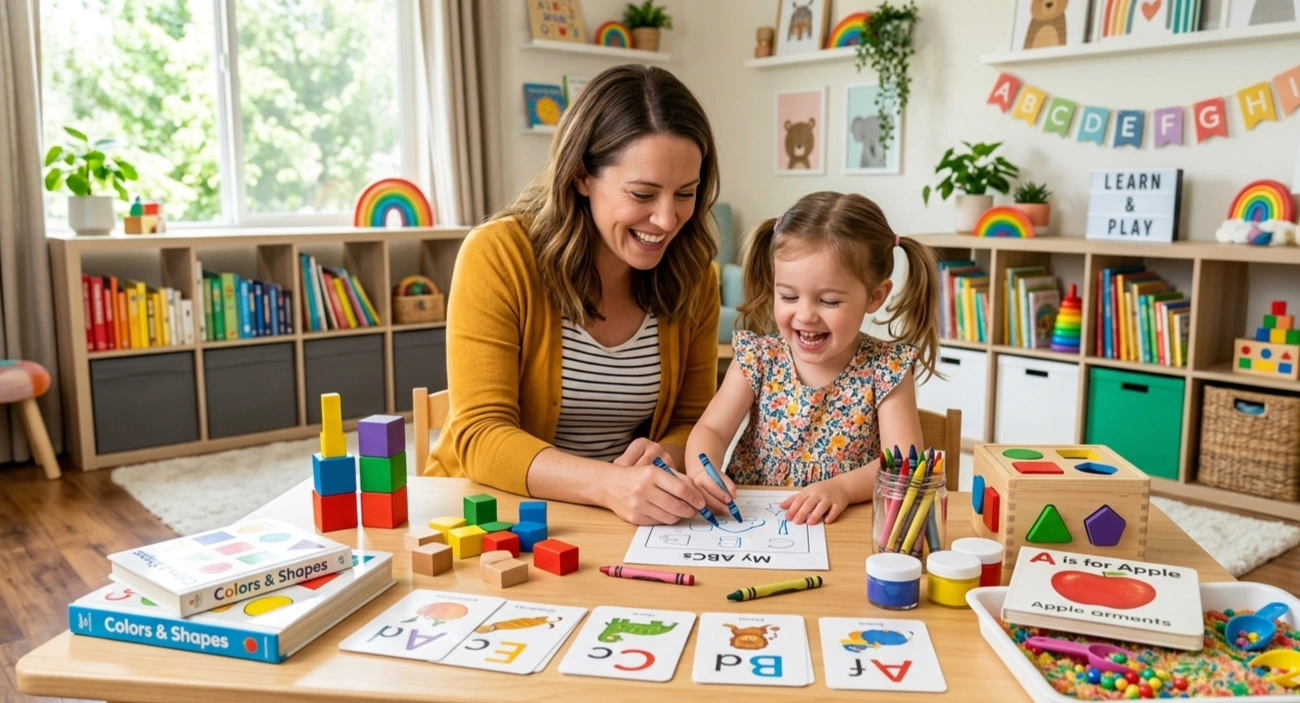
- Preschool learning at home can be fun, simple, and effective.
- Everyday activities help children improve motor, language, and thinking skills.
- Play-based learning keeps preschoolers engaged longer.
- Parents do not need expensive materials for meaningful learning.
- Consistent short activities build confidence and school readiness.
Introduction
10 Fun Preschool Learning Activities at Home
Simple, hands-on preschool activities that help children build early literacy, math, language, creativity, motor, observation, and problem-solving skills through play.
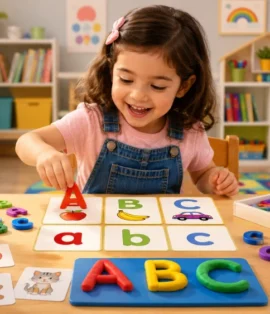
1. Alphabet Hunt Activity
| Overview | Turn letter practice into a fun treasure hunt around the house. This activity helps preschoolers recognize letters while connecting them with familiar objects. |
|---|---|
| What You Need |
|
| How to Play | Hide a few letters around the room. Ask your child to find one letter at a time, name it, and say its sound. Then ask them to find an object that starts with that sound. |
| Example | B → ball | C → cup | D → doll | S → spoon Start with letters your child already knows and gradually introduce new ones. |
| Skills Developed | Letter recognition, beginning phonics awareness, vocabulary, observation, and listening skills. |
| Make It Easier | Use only 3–5 familiar letters and give clues about where to find them. |
| Make It More Challenging | Ask your child to think of two or three words that begin with the letter they find. |
2. Sensory Bin Play
| Overview | Sensory play gives preschoolers an opportunity to explore different textures while practicing simple learning concepts. |
|---|---|
| What You Need |
|
| How to Play | Hide large alphabet letters, numbers, shapes, or toy animals in the container. Let your child search for them and identify each item. If your child finds 5, ask them to count five objects. |
| Learning Ideas | Find and name letters; match numbers; identify shapes; sort objects by color; count hidden objects; name animals or everyday objects. |
| Skills Developed | Fine motor skills, letter and number recognition, sorting, vocabulary, concentration, and sensory exploration. |
| Parent Tip | Always supervise young children during sensory play and choose materials appropriate for your child’s age. |
3. Story Time With Action
| Overview | Reading together supports early language development. Adding movement and questions turns ordinary story time into an interactive learning activity. |
|---|---|
| How to Make It Interactive |
|
| Questions to Ask |
|
| Skills Developed | Vocabulary, listening, communication, memory, imagination, and emotional understanding. |
| Make It More Fun | After the story, let your child draw a favorite character or create a simple paper puppet and retell the story. |
4. Color Sorting Games
| Overview | Color sorting helps preschoolers recognize colors while developing early classification and math skills. |
|---|---|
| Simple Setup | Collect blocks, pom-poms, crayons, socks, cups, or toy objects. Place colored bowls or sheets of paper on the floor. |
| How to Play | Ask your child to put each object with the matching color: red object → red group; blue object → blue group; yellow object → yellow group. |
| Learning Questions | Which group has more? Which group has fewer? Can you find something green? What color is this? Can you make a group with three red objects? |
| Skills Developed | Color recognition, sorting and classification, early math understanding, concentration, and visual recognition. |
| Make It More Challenging | Ask your child to sort objects by two characteristics, such as color and size. |
👉🏻 You can also help young children practice color recognition with these color learning activities for toddlers.
5. DIY Counting Activities
| Overview | Everyday objects can become simple math materials. Counting activities help children understand numbers through hands-on practice. |
|---|---|
| What You Can Use | Fruits, toys, building blocks, pasta, cups, and large household objects. |
| How to Play | Start with small groups. Ask your child to count slowly while touching each item once. |
| Try These Questions | Can you count 5 blocks? How many apples are there? Which group has more? Which group has fewer? Can you give me 3 cars? |
| Younger Preschoolers | Start with numbers from 1 to 5 and focus on counting objects correctly. |
| Older Preschoolers | Practice counting from 1 to 10 or 1 to 20 and introduce comparisons such as more, fewer, and the same. |
| Skills Developed | Number recognition, counting, one-to-one correspondence, comparison, and early problem-solving. |
| Make It More Fun | Let your child be the “teacher” and ask you to count a group of objects. |
👉🏻 For additional hands-on practice, explore our math worksheets for preschool and kindergarten to help children build early number and counting skills.
6. Finger Painting Fun
| Overview | Finger painting gives preschoolers a creative way to explore colors, shapes, patterns, and early writing concepts. |
|---|---|
| Why It Works | Children can use their fingers and hands to make lines, dots, circles, patterns, and pictures. This encourages creativity while developing hand coordination. |
| Learning Extensions | Practice colors, shapes, patterns, simple letters, numbers, lines, and curves. Ask your child to paint a large circle, make five dots, or trace a simple letter using paint. |
| Parent Tip | Use washable, non-toxic paint and protect the table or floor with old newspapers or a washable mat. |
| Skills Developed | Creativity, hand-eye coordination, fine motor control, color recognition, and early pre-writing skills. |
7. Music and Movement Activities
| Overview | Music and movement make learning active and memorable. Preschoolers can practice language, numbers, letters, and body coordination while singing and moving. |
|---|---|
| Activity Ideas | Alphabet songs, counting songs, action rhymes, freeze dance, animal movement games, and clapping patterns. |
| How to Play | Play a familiar children’s song and encourage simple movements. Pause the music and ask your child to freeze. You can also clap a simple pattern and ask your child to copy it. |
| Example | Clap – Clap – Tap Ask your child to repeat the pattern. |
| Skills Developed | Memory, coordination, listening, language development, rhythm, and confidence. |
| Make It More Educational | Create movement instructions such as “Jump three times,” “Touch your nose and then your toes,” or “Clap five times.” |
8. Shape Matching Games
| Overview | Shape matching helps preschoolers recognize common shapes and connect them with objects they see every day. |
|---|---|
| What You Need | Cut simple shapes from colored paper: circle, triangle, square, and rectangle. |
| How to Play | Place the paper shapes on a table or floor. Ask your child to find objects around the house that have a similar shape. |
| Examples | Clock → circle; window → rectangle; book → rectangle; floor tile → square. |
| Skills Developed | Shape recognition, observation, matching, visual discrimination, and early geometry understanding. |
| Make It More Challenging | Ask your child to draw a shape and find something around the house that matches it. Ask: “How many sides does a triangle have?” and “Which shape has no corners?” |
👉🏻 For more hands-on practice, try these shape counting activities for kids to help children recognize and count shapes.
9. Nature Walk Learning
| Overview | A short walk outside can become a wonderful preschool learning activity. Children can observe nature while practicing colors, counting, vocabulary, and sensory awareness. |
|---|---|
| Things to Explore | Leaves, flowers, birds, trees, different colors, interesting sounds, clouds, and weather changes. |
| Simple Nature Hunt | Find something green; find a small leaf; find something soft; find something rough; find a flower; listen for two different sounds. |
| Learning Questions | What color is this flower? How many birds can you see? Is this leaf big or small? What sound can you hear? How does this leaf feel? |
| Skills Developed | Observation, vocabulary, counting, sensory awareness, curiosity, and communication. |
| Parent Tip | Let your child lead the exploration when possible. Their questions and discoveries can become natural learning opportunities. |
10. Simple Preschool Science Experiments
| Overview | Simple science experiments can introduce preschoolers to prediction, observation, and cause-and-effect thinking. |
|---|---|
| Easy Activity | Sink or Float: Fill a bucket or container with water. Choose a few safe household objects and ask your child to predict whether each object will sink or float. |
| Examples | Spoon, leaf, small plastic toy, paper, and cork. |
| How to Play | Before placing each object in the water, ask: “Do you think it will sink or float?” Let your child make a prediction, test the object, and observe what happens. Then ask: “Were you right?” |
| Skills Developed | Prediction, observation, critical thinking, problem-solving, and communication. |
| Extend the Activity | Create two simple groups: Sinks and Floats. Let your child place each tested object into the correct group. |
| Parent Tip | Choose child-safe objects and supervise the activity closely around water. |
Common Mistakes Parents Should Avoid
Too Much Screen Time
- Interactive activities are often more beneficial than passive screen use.
Pressuring Children
- Every child learns at their own pace.
Overcomplicated Activities
- Simple activities are usually the most effective for preschoolers.
Discover free preschool learning books in PDF format for young learners. These educational e-books are designed for preschool and kindergarten children and cover alphabet learning, phonics, early math, vocabulary, stories, coloring, and other fun activities. Parents and teachers can use these printable learning resources to make early learning simple, engaging, and enjoyable.
Conclusion
The best preschool activities at home are the ones filled with laughter, curiosity, and connection. Even a few minutes of playful learning each day can make a big difference in your child’s growth and confidence.
Start small, stay consistent, and enjoy the learning journey together.
Frequently Asked Questions About Preschool Activities at Home
Some of the best preschool activities at home include alphabet hunts, counting games, color sorting, story time, sensory play, shape matching, music and movement, nature walks, art activities, and simple science experiments. Choose activities based on your child's age and interests.
Keep learning active and playful. Use songs, movement, stories, household objects, drawing, games, and hands-on activities. Preschoolers often learn best when they can explore and participate rather than simply listen.
Many preschool activities can be completed in about 10 to 20 minutes, depending on the child's age, interest, and attention span. It is perfectly fine to stop earlier if your child becomes tired or loses interest.
You can introduce early skills such as letters, sounds, numbers, counting, colors, shapes, vocabulary, fine motor skills, listening, creativity, and simple problem-solving through everyday play and activities.
No. Many effective activities use simple materials you already have, such as paper, crayons, blocks, household objects, books, cups, and recycled materials. The learning interaction is often more important than the cost of the materials.
Choose activities that match your child's age, interests, and current abilities. Start with simple tasks and gradually increase the challenge as your child becomes more confident.
VedaPlay Toys Review (2026) | Montessori Wooden Learning Toys
August 29, 2026[…] a more complete learning environment, parents can combine VedaPlay toys with our collection of Preschool Home Activities and Printable Worksheets for additional hands-on learning […]