
Key Highlights
- Toddlers learn colors best through play and repetition.
- Daily activities help children recognize colors naturally.
- Simple games and crafts make learning more exciting.
- Positive encouragement improves confidence and memory.
- Teaching one color at a time prevents confusion.
Introduction
Colors are one of the first exciting things toddlers notice in the world around them. From bright red apples to blue skies and colorful toys, children are naturally attracted to colors from an early age.
However, many parents wonder how to start teaching colors to toddlers without making learning stressful. The good news is that toddlers learn best through fun experiences, simple conversations, and everyday play.
You do not need expensive toys or complicated lessons. With patience and creativity, you can help your child recognize and name colors naturally.
In this guide, you will learn simple and practical ways to make teaching colors to toddlers easy and enjoyable.
Why Learning Colors Is Important for Toddlers
Learning colors helps toddlers in many areas of development.
Color learning supports:
- Visual recognition skills
- Language development
- Memory improvement
- Sorting and matching abilities
- Early math and reading readiness
Most importantly, learning colors builds confidence. When toddlers correctly identify colors, they feel proud and excited to learn more.
When Should Toddlers Learn Colors?
Every child learns at a different pace. Generally, toddlers start noticing colors around 18 months and begin naming them between ages 2 and 3.
Do not worry if your child takes longer. Repetition and playful learning matter more than speed.
Signs your toddler is ready:
- Shows interest in colorful objects
- Enjoys sorting toys
- Repeats simple words
- Points to pictures and objects
Start with Basic Colors First
Teaching too many colors at once can confuse toddlers.
Instead, begin with a few simple colors.
Best starter colors:
- Red
- Blue
- Yellow
- Green
Once your child understands these colors, slowly introduce more shades like orange, purple, pink, black, and white.
Helpful tip:
Focus on one color each week for better understanding.
Use Everyday Objects to Teach Colors
Toddlers learn better when they connect colors with real-life objects.
Examples:
| Color | Everyday Object |
|---|---|
| Red | Apple |
| Yellow | Banana |
| Blue | Sky |
| Green | Leaf |
During daily routines, casually talk about colors.
For example:
“Look at your blue cup.”
“Your shoes are black.”
“This mango is yellow.”
Simple repetition helps children remember colors naturally.
Make Color Learning Fun Through Play
Play-based learning keeps toddlers engaged and excited.
Easy Color Activities for Toddlers
1. Color Sorting Game
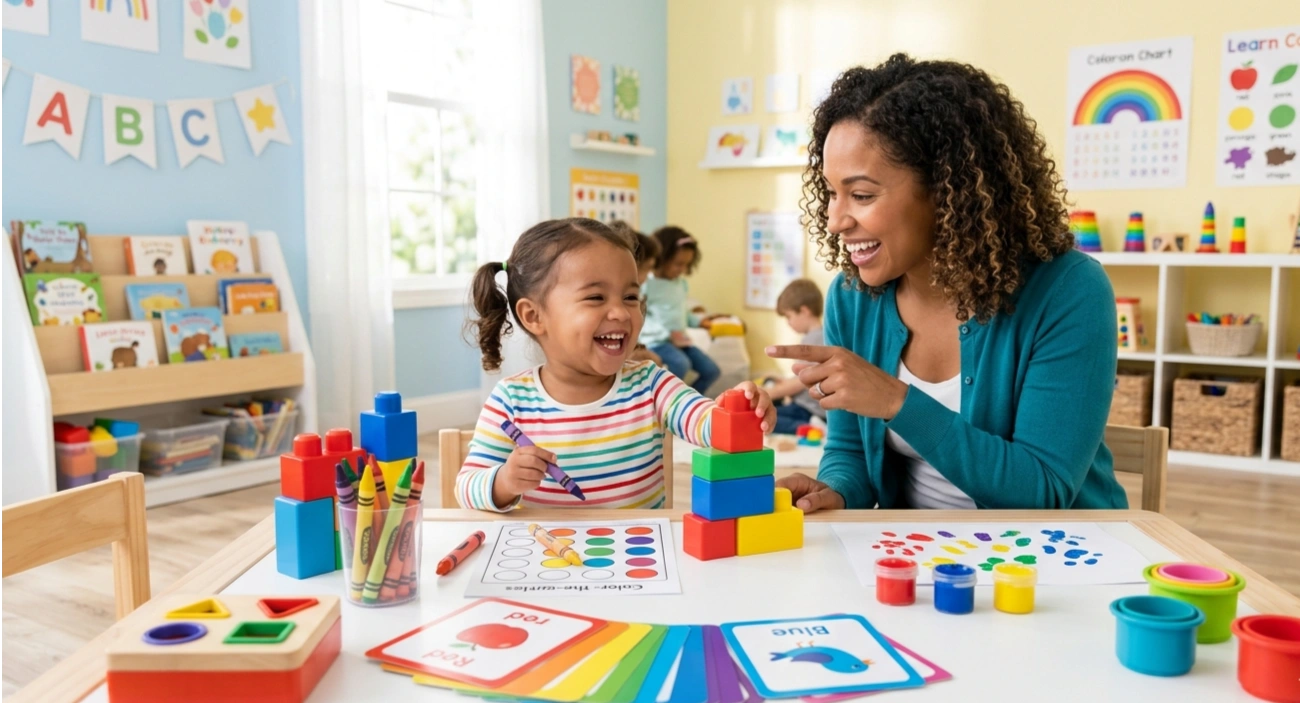
Give your toddler colorful blocks, pom-poms, or toys.
Ask them to group objects by color.
This activity improves:
- Color recognition
- Fine motor skills
- Sorting ability
2. Rainbow Hunt Activity
Ask your toddler to find objects around the house in a specific color.
Example:
“Can you find something green?”
Children love moving around while learning.
3. Finger Painting Fun
Painting is one of the best sensory activities for teaching colors to toddlers.
Let your child:
- Mix colors
- Create handprints
- Explore shades
At the same time, talk about the colors they use.
4. Color Matching Cards
Use printable worksheets, flashcards, or homemade cards.
Ask your toddler to:
- Match same-colored objects
- Point to colors
- Name colors aloud
This improves memory and attention.
5. Sing Color Songs
Music helps toddlers remember words faster.
Popular color songs include:
- Rainbow songs
- Color train songs
- Preschool learning rhymes
Singing together makes learning joyful and interactive.
Read Colorful Books Together
Picture books are wonderful for teaching colors naturally.
Choose books with:
- Bright illustrations
- Simple words
- Repeated color names
While reading:
- Point at objects
- Ask simple questions
- Encourage your child to repeat colors
Reading also strengthens bonding time between parents and children.
Use Outdoor Learning Opportunities
Nature is filled with colors.
Take your toddler outside and explore together.
Outdoor color ideas:
- Green grass
- Blue sky
- Yellow flowers
- Brown tree trunks
Outdoor learning keeps toddlers active while making lessons more memorable.
Avoid Common Mistakes While Teaching Colors
Sometimes parents accidentally make learning harder.
Things to Avoid
Teaching Too Many Colors Together
Start small and move slowly.
Forcing Children to Answer
If your toddler does not respond correctly, avoid pressure.
Instead, gently repeat the correct answer.
Expecting Fast Results
Toddlers need time and repetition.
Learning happens gradually through daily exposure.
Best Tips for Teaching Colors to Toddlers
Simple Parenting Tips
Repeat Often
- Use color words naturally throughout the day.
Keep Sessions Short
- Toddlers have short attention spans.
- 10–15 minutes is enough.
Celebrate Small Wins
- Praise your child when they correctly identify a color.
- Positive encouragement builds motivation.
Use Hands-On Activities
- Children learn faster when they touch, move, and play.
Printable Worksheets Can Help Too
Printable color worksheets are excellent for preschool learning at home.
They help toddlers:
- Trace colors
- Match objects
- Practice coloring
- Improve pencil control
Parents and teachers can combine worksheets with games for better results.
Conclusion
Teaching colors to toddlers does not need to be difficult. In fact, the best learning happens during simple everyday moments filled with fun, conversation, and play.
By using games, songs, books, outdoor activities, and colorful objects, you can help your child build strong early learning skills with confidence.
Remember, every toddler learns differently. Be patient, celebrate progress, and enjoy the beautiful learning journey together.
Small daily activities today can create a lifelong love for learning tomorrow.

10 Fun Preschool Activities At Home For Kids | KEL
August 16, 2026[…] 👉🏻 You can also help young children practice color recognition with these color learning activities for toddlers. […]
VedaPlay Toys Review (2026) | Montessori Wooden Learning Toys
August 29, 2026[…] while solving simple challenges. Parents can also introduce creative learning through our Teach Colors to Toddlers activities and Fun Shape Games to reinforce colour and shape recognition in enjoyable […]