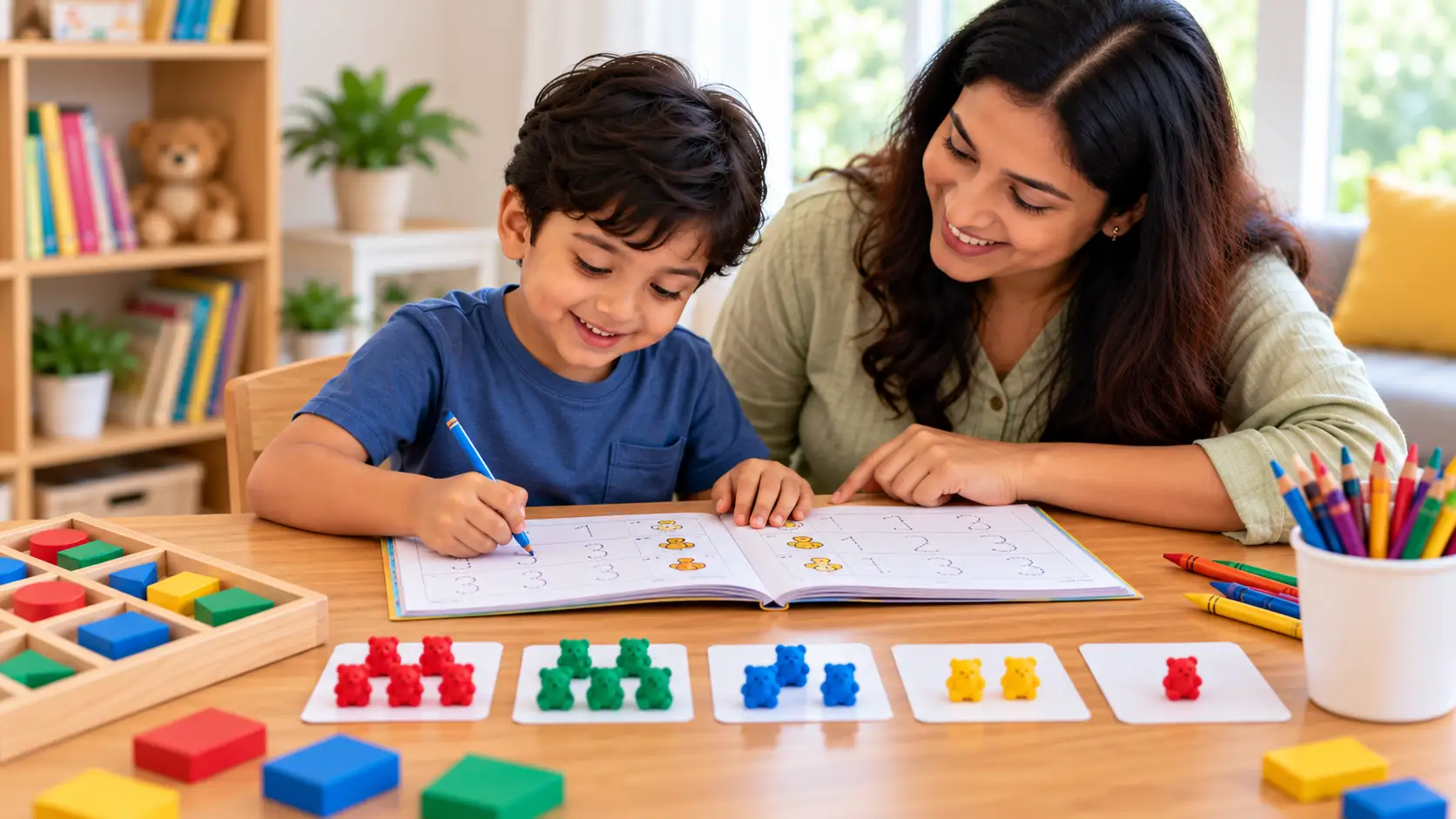
Learning numbers is an important step in a child's early maths journey. Before children begin solving simple addition problems or writing numbers independently, they need to understand what numbers look like and what they represent.
The good news is that teaching numbers doesn't have to involve sitting at a desk with a workbook. Everyday objects, colourful blocks, toys and simple games can make learning enjoyable for little ones.
With the right number recognition activities for preschoolers, parents and teachers can help children become familiar with numbers while building their counting skills and confidence.
In this guide, you'll discover easy activities to help children recognise numbers, understand quantities and practise numbers from 1 to 10 at home or in the classroom.
What Is Number Recognition?
Number recognition is the ability to identify numbers by their appearance. For example, when a child sees the number 3 on a card and correctly identifies it as three, they are practising number recognition.
It is different from simply counting aloud. A child may be able to say “one, two, three, four, five” in the correct order but still find it difficult to identify the number 4 when shown on a page.
Children gradually learn to connect three important things:
-
The numeral: What the number looks like, such as 4.
-
The number name: What we call it, such as four.
-
The quantity: How many objects it represents, such as four blocks.
Practising these connections through play helps children develop a stronger understanding of early maths.
Why Is Number Recognition Important for Preschoolers?
Number recognition provides a foundation for many mathematical skills children learn later.
Here are some benefits of practising numbers during the preschool years.
1. Builds early maths skills
Recognising numbers helps children prepare for counting, comparing quantities and understanding simple addition and subtraction.
2. Develops counting confidence
When children connect written numbers with actual objects, counting becomes more meaningful than simply memorising number sequences.
3. Encourages independence
As children become familiar with numbers, they can identify them on books, calendars, clocks, toys and everyday objects.
4. Prepares children for kindergarten
Basic number recognition can help children feel more comfortable with classroom activities involving counting, number writing and simple maths worksheets.
Every child develops at their own pace, so keep activities relaxed and enjoyable rather than turning them into tests.
12 Fun Number Recognition Activities for Preschoolers
You don't need expensive learning materials to introduce numbers. Many useful activities can be created using things you already have at home.
2. Count and Touch
Children sometimes skip objects or count the same object more than once. This activity helps them practise counting objects one at a time.
What you need: Toys, crayons, spoons or building blocks.
Place a small group of objects in front of your child. Ask them to touch each object while counting aloud.
Once they finish, show them the matching number card.
For example, your child might count five crayons and then identify the number 5.
This activity introduces one-to-one correspondence, which means understanding that each object counted represents one number in the sequence.
3. Play with Number Flashcards
Number flashcards offer a quick way to practise identifying numerals.
Make a set of cards featuring numbers 1 to 10. Show your child one card at a time and ask them to name the number.
You can make the activity more engaging by asking your child to:
-
Find the matching number among three cards.
-
Arrange number cards in order.
-
Pick a card and clap that many times.
-
Find the same number on a page or around the house.
Keep the sessions short. A few minutes of practice can be more useful than a long session that leaves your child frustrated.
4. Go on a Number Hunt
Numbers appear in many places around us. Turn your home into a simple number-learning environment.
Ask your child to find numbers on calendars, books, clocks, packaging or other safe household items.
You might say, “Can you find the number 2?” and help them look around the room.
When they spot the number, ask them to point to it and say its name.
For younger preschoolers, begin with just two or three target numbers. Introduce more numbers as their recognition improves.
5. Build Numbers with Blocks
Building blocks can help children explore numbers while developing their fine motor skills.
Write numbers on small pieces of paper and place them beside a collection of blocks.
Ask your child to build a tower with the matching number of blocks. For instance, the number 4 means building a tower with four blocks.
You can also use blocks to create simple number patterns or arrange number cards from smallest to largest.
This activity works well for children who enjoy building and hands-on play.
6. Trace Numbers with Fingers
Before children become comfortable holding a pencil, they can explore the shapes of numbers using their fingers.
Write large numbers on paper and show your child how to trace each numeral with their index finger.
Say the number aloud as they trace it. Encourage them to notice where the number starts and which direction the line moves.
You can also draw large numbers in sand, use a finger to trace them on a tray of flour under close adult supervision, or practise tracing numbers on a reusable writing board.
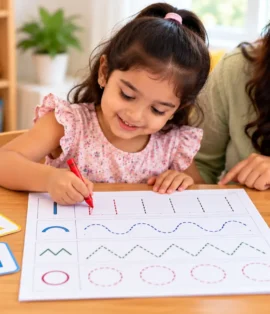
Once your child becomes familiar with the shapes, introduce number tracing worksheets to help them practise pencil control.
7. Hop to the Correct Number
Add some movement to number practice with a simple floor game.
Write numbers on paper and place the sheets on the floor with enough space between them.
Call out a number and ask your child to hop, step or walk to the matching card.
For example, when you say “six,” your child finds the number 6.
You can also ask them to perform an action a certain number of times, such as jumping three times or clapping four times.
Keep the space clear and supervise your child throughout the activity.
8. Match Numbers with Fingers
Our fingers provide a convenient way to represent small quantities.
Show your child a number card and ask them to hold up the matching number of fingers.
For example:
-
Number 1: Hold up one finger.
-
Number 3: Hold up three fingers.
-
Number 5: Hold up five fingers.
You can reverse the game by showing a number of fingers and asking your child to find the corresponding number card.
This activity helps children connect a written numeral with a quantity they can see and represent themselves.
9. Play a Number-Matching Game
Create two sets of cards. One set should contain numerals, while the other contains groups of pictures showing the corresponding quantities.
For example, one card might display the number 4, while another shows four apples.
Shuffle the cards and ask your child to find the matching pairs.
Start with numbers 1 to 5. Once your child becomes comfortable, add numbers up to 10.
This game encourages children to recognise numbers and compare them with groups of objects.
10. Make Numbers with Playdough
Playdough gives children an opportunity to explore the shapes of numbers using their hands.
Roll the playdough into long pieces and help your child bend them into numerals. Begin with simple shapes and gradually introduce numbers that require more curves or lines.
Place a number card beside each finished shape so your child can compare the playdough numeral with the printed number.
You can also ask your child to make three small playdough balls and place them next to the number 3.
This combines number recognition, quantity practice and hands-on exploration.
11. Count Favourite Toys
Use your child's favourite toys to practise recognising and understanding numbers.
Ask them to collect a small number of toy cars, dolls, animals or building blocks.
Count the toys together and then show your child the matching numeral.
For example, if they collect two toy cars, help them identify the number 2.
You can make the game more challenging by asking questions such as:
-
Can you bring me three blocks?
-
How many toy cars do you have?
-
Which group has more toys?
-
Can you find the number that matches your toys?
Using familiar objects can make number learning feel natural and relevant to everyday life.
12. Practise with Printable Number Recognition Worksheets
Hands-on games are excellent for introducing numbers, while worksheets give children an opportunity to practise what they have learned.
Printable worksheets can help preschoolers identify numerals, match numbers with quantities and become familiar with the shapes of written numbers.
Look for activities that include:
-
Number identification: Find or circle a particular numeral.
-
Number matching: Connect numerals with groups of objects.
-
Number tracing: Follow dotted lines to practise forming numbers.
-
Counting pictures: Count objects and select the correct number.
-
Number colouring: Colour pictures or sections associated with a specific number.
Choose worksheets that suit your child's current ability. A child who is just beginning to recognise numbers may benefit from activities featuring only numbers 1 to 5, while a more confident learner can practise numbers up to 10.
Explore printable maths worksheets for preschoolers to find suitable learning resources for your child's practice routine.
For the best experience, combine worksheet practice with counting games, toys and everyday activities. Worksheets should support learning through play, not replace it.
At What Age Should Children Recognise Numbers?
Children develop number skills at different rates, and there is no single age at which every child will recognise all numerals.
As a general guide:
-
Around ages 2–3: Children may begin noticing numbers and exploring counting through songs, books and everyday routines.
-
Around ages 3–4: Many children begin recognising some written numbers and matching small groups of objects with quantities.
-
Around ages 4–5: Children may become more confident identifying numbers, counting objects and practising number writing.
These are broad developmental patterns, not strict milestones. Some children will learn certain numbers earlier, while others need more repetition and practice.
Focus on your child's progress and interest rather than comparing them with other children.
How to Help Your Child Learn Numbers 1–10
If your child is just starting to recognise numbers, introducing all ten at once may feel overwhelming.
Try these simple strategies to make learning easier.
Start small. Begin with numbers 1, 2 and 3 before introducing more numerals.
Repeat numbers in different ways. Use flashcards, toys, songs, tracing and counting games to reinforce the same numbers.
Connect numbers with quantities. Show your child that the numeral 4 represents four actual objects.
Practise for short periods. A five- to ten-minute activity may be enough, depending on your child's interest and attention.
Celebrate effort. Encourage your child when they recognise a number or attempt an activity, even if they need help.
Make use of everyday opportunities. Count steps, fruits, toys and objects during normal routines.
Most importantly, let your child learn at a comfortable pace. Regular, enjoyable practice can help build confidence over time.
Common Mistakes to Avoid When Teaching Number Recognition
A few small changes can make number-learning activities more effective.
Introducing too many numbers at once: Focus on a manageable group of numbers before adding more.
Teaching counting without showing quantities: Saying numbers aloud is useful, but children also need opportunities to connect number names with objects.
Expecting perfect handwriting too early: Recognising a number and writing it independently are different skills. Allow time for each to develop.
Making every activity feel like a test: Use games, questions and playful repetition rather than repeatedly testing your child.
Rushing through worksheets: The aim is to understand numbers, not to finish a page as quickly as possible.
A positive learning environment helps children feel comfortable exploring new concepts and making mistakes.
Frequently Asked Questions
Number flashcards, counting toys, matching numerals with objects, number hunts and tracing activities are useful ways to introduce numbers. Printable number recognition worksheets can provide additional practice once children become familiar with the numerals.
Start with a few numbers, such as 1, 2 and 3. Use toys, picture books, number cards and everyday objects to show your child what each number looks like and how it relates to a quantity. Keep activities short and enjoyable.
Introduce numbers gradually and practise them through different activities. Match number cards with objects, count toys, play number hunts and revisit familiar numbers regularly. Add new numbers as your child becomes more confident.
Counting involves saying numbers in sequence and, eventually, counting objects accurately. Number recognition means identifying a written numeral, such as 5. Children benefit from practising both skills and learning how numerals connect with quantities.
Yes. Age-appropriate worksheets can help children identify numbers, match numerals with quantities, trace number shapes and practise counting. They work best when combined with hands-on activities and adult guidance rather than used as the only learning method.
Short, regular practice sessions can help children become familiar with numbers. You can include number games in daily routines and offer a worksheet when your child is interested. Adjust the duration and difficulty to suit your child's attention and current abilities.
Make Number Learning Fun with Kids Easy Learning
Helping your child recognise numbers doesn't require complicated lessons or expensive materials. A few toys, number cards, everyday objects and simple games can turn early maths into an enjoyable part of the day.
As your child becomes more comfortable identifying numerals and matching them with quantities, introduce new activities to keep learning interesting.
Printable maths worksheets can provide another way to practise these skills at home or in preschool.
Explore Kids Easy Learning for printable learning resources that help make early education engaging, practical and fun for little learners.