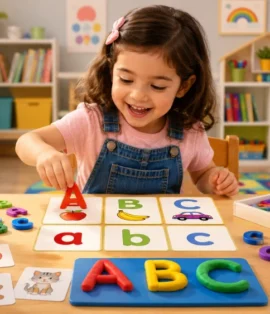
Fun Math Activities for Preschoolers at Home

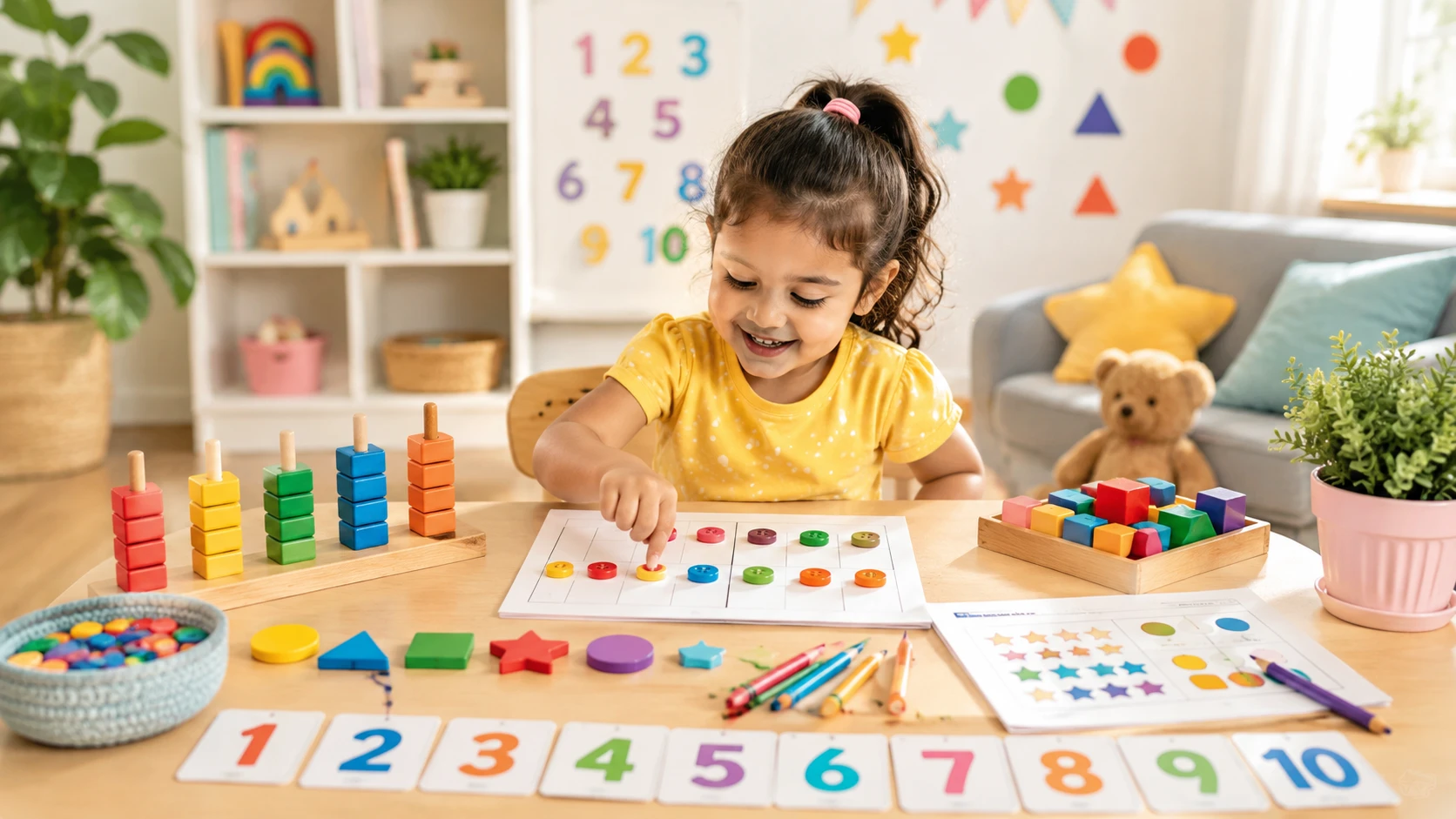
Fun math activities for kids at home with counting game

Key Highlights

  • Learn simple math through everyday household objects.
  • Practice counting with toys, snacks, blocks, and other familiar items.
  • Use sorting and matching games to develop early math thinking.
  • Make number learning fun with movement and hands-on activities.
  • Introduce shapes and patterns through playful activities.
  • Use printable worksheets alongside games for extra practice.
  • Keep preschool math sessions short, simple, and enjoyable.
  • Encourage children instead of focusing on perfect answers.
Teaching math to preschoolers does not have to feel like a formal lesson. Young children learn important early math skills naturally when they count, sort, compare, match, build, move, and explore.

Simple math activities for preschoolers can turn everyday moments at home into fun learning opportunities. You do not need expensive educational toys or complicated lesson plans. Many activities can be done with toys, household objects, paper, crayons, blocks, and other things you already have.

Whether you are a parent, preschool teacher, or homeschooling parent, playful math activities can help children develop number awareness, counting skills, logical thinking, problem-solving, and confidence.

In this guide, you'll discover easy math activities that preschoolers can enjoy at home while learning important early math concepts.


Why Math Activities Are Important for Preschoolers

Early math learning is more than memorizing numbers. Preschoolers gradually learn how numbers, quantities, shapes, patterns, and comparisons work through everyday experiences.

Fun math activities can help children:
  • Recognize numbers
  • Practice counting
  • Understand quantities
  • Compare objects
  • Identify shapes
  • Recognize patterns
  • Improve problem-solving skills
  • Develop concentration
  • Build confidence with numbers
The most important goal is to make early math feel enjoyable rather than stressful.

1. Count Everyday Objects

One of the easiest ways to introduce math at home is to count objects your child already knows.

You can ask your child to count:
  • Toys
  • Blocks
  • Fruits
  • Pencils
  • Spoons
  • Books
  • Socks
  • Cars
For example, place five blocks in front of your child and ask:

"How many blocks are there?"

Then let your child touch each block while counting aloud.

Make It More Challenging

Once your child becomes comfortable counting small groups, ask simple questions such as:
  • "Can you give me three blocks?"
  • "Which group has more?"
  • "Can you add one more?"
  • "How many do we have now?"
These simple questions help children connect number words with actual quantities.
 

2. Try a Number Hunt Game

Children love searching for hidden objects, so turn number learning into a treasure hunt.

Write numbers on small pieces of paper and hide them around a room.

Then give your child simple challenges:
  • Find number 2.
  • Find number 5.
  • Find number 8.
  • Find the biggest number.
  • Put the numbers in order.
After finding the numbers, ask your child to say each number aloud.

Skills Developed

This activity helps improve:
  • Number recognition
  • Memory
  • Attention
  • Listening
  • Movement
  • Number sequencing
Keep the game short and adjust the numbers according to your child's age and ability.
 

3. Practice Counting With Snacks

Snack time can become a simple math lesson.

Use small portions of foods such as:
  • Crackers
  • Grapes
  • Cereal
  • Carrot pieces
  • Banana slices
Ask questions such as:
  • "Can you count five crackers?"
  • "How many grapes do you have?"
  • "If you eat one, how many are left?"
This introduces counting and simple addition or subtraction through a familiar daily routine.

Parent Tip

Always choose age-appropriate foods and supervise young children while they are eating.

4. Play a Sorting Game

Sorting is an important early math skill because it teaches children how to identify similarities and differences.

Collect safe household objects and ask your child to sort them.

You can sort objects by:
  • Color
  • Size
  • Shape
  • Type
  • Texture
For example, place red and blue blocks together and ask your child to separate them into two groups.

Then ask:

"Which group has more?"

This combines sorting with counting and comparison.


5. Create Simple Number Matching Activities

Number matching helps children understand that a written number represents a quantity.

Write numbers from 1 to 10 on paper cards.

Then place groups of objects beside them.

For example:

Number 3 → 3 blocks

Number 5 → 5 buttons

Number 7 → 7 crayons

Ask your child to match each number with the correct quantity.

Why It Helps

This activity connects:

Number → Quantity → Counting

That connection is an important foundation for later math learning.


6. Explore Patterns With Toys

Patterns are everywhere, and preschoolers can learn them through simple objects.

Create patterns such as:

Red – Blue – Red – Blue

or

Block – Car – Block – Car

Ask your child:

"What comes next?"

Once they understand simple repeating patterns, create slightly more challenging ones.

Pattern Ideas
Red – Yellow – Red – Yellow
Big – Small – Big – Small
Circle – Square – Circle – Square
Clap – Jump – Clap – Jump

Pattern activities encourage observation, memory, and early logical thinking.

For another playful way to practice patterns, children can also explore our number pattern game.
 
Once children are comfortable with numbers, pattern games for kids can help develop early logical thinking.


7. Learn Shapes Around the House

You don't need special flashcards to teach shapes.

Look for shapes in everyday objects.

Examples
  • Clock → Circle
  • Window → Rectangle
  • Door → Rectangle
  • Plate → Circle
  • Tile → Square
Take a short shape hunt around your home and ask your child to identify what they see.

Make It Fun

Ask questions such as:

"Can you find something shaped like a circle?"

"How many rectangles can you find?"

This turns everyday observation into an early geometry activity.


8. Build Numbers With Playdough

Playdough is a fun way to combine creativity and early math learning.

Ask your child to roll playdough into long pieces and use them to form numbers.

Start with simple numbers such as:

1, 2, 3, 4 and 5

While forming each number, say the number aloud.

Benefits

Playdough number activities can support:
  • Fine motor development
  • Hand strength
  • Number recognition
  • Hand-eye coordination
  • Creativity
This is especially useful for preschoolers who enjoy hands-on learning.


9. Play a "More or Less" Game

Give your child two small groups of objects.

For example:
  • Group A: 3 blocks
  • Group B: 5 blocks
Ask:

"Which group has more?"

Then ask:

"Which group has fewer?"

Once your child understands the concept, try different quantities.

This introduces the early idea of comparing numbers without requiring formal math worksheets.

For additional practice with comparing quantities, you can also try our greater than or less than game.


10. Try a Simple Counting and Adding Game

Use toys, blocks, or other safe objects to introduce basic addition.

Place two blocks on the table.

Then add one more.

Ask:

"We had two blocks. Now we added one. How many blocks do we have?"

Let your child physically move and count the objects.

This makes addition easier to understand because children can see and touch the quantities.

For more hands-on practice, try our count and add game.


11. Play a Movement Math Game

Preschoolers often learn better when they can move.

Turn numbers into an active game.

Write numbers from 1 to 10 on paper and place them on the floor.

Then give instructions such as:
  • "Jump to number 3."
  • "Stand on number 7."
  • "Touch number 5."
  • "Jump from 2 to 4."
You can also combine movement with counting:

"Let's do five jumps together."

This combines physical activity, listening, counting, and number recognition.
 

12. Use Drawing and Coloring for Early Math

Drawing and coloring can also support early math skills.

Ask children to:
  • Draw three circles.
  • Color five stars.
  • Draw two big squares.
  • Color four triangles.
  • Make a pattern using two colors.
These simple activities allow children to practice numbers, shapes, colors, and patterns at the same time.

Creative DIY Math Activities for Preschoolers

You can create simple learning materials using paper and household items.

Paper Number Cards

Write numbers on small cards and use them for:
  • Number recognition
  • Number ordering
  • Matching
  • Number hunts
  • Simple games
  • Button Counting
Place buttons or other safe objects into groups and ask children to count them.

Number Collage

Write a large number on paper and let your child decorate it with stickers, drawings, or craft materials.

Shape Collage

Cut basic shapes from paper and let your child create a picture using circles, squares, triangles, and rectangles.

These activities combine math with creativity.

Printable Worksheets Can Support Math Practice

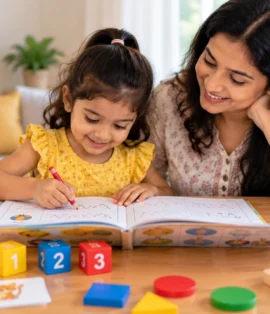
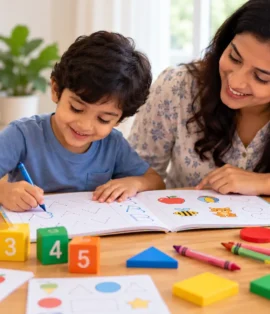
Hands-on games are excellent for preschool learning, but printable worksheets can provide additional structured practice.

Worksheets can help children practice:
  • Number tracing
  • Counting
  • Number matching
  • Shapes
  • Patterns
  • Simple addition
  • Coloring numbers
For more structured practice, explore our math worksheets for preschool and kindergarten.

You can also find free preschool worksheets for additional learning activities at home.

The best approach is to combine worksheets with games, movement, conversation, and hands-on activities.

Simple 20-Minute Math Routine for Preschoolers

You don't need to spend an hour teaching math.

A simple routine can be enough.

Activity Time
Counting Game 5 Minutes
Number Practice 5 Minutes
Hands-On Math Activity 5 Minutes
Shape or Pattern Game 5 Minutes

Some days your child may want to continue longer. On other days, they may lose interest quickly.

That's okay.

The goal is to create positive learning experiences rather than force a fixed schedule.


Tips for Making Math Fun at Home

Keep Activities Short

Preschoolers have developing attention spans. Short activities are often more effective than long lessons.

Use Everyday Objects

You can teach counting and comparison using toys, food, books, clothes, and household objects.

Let Children Touch and Move

Hands-on learning helps children connect abstract numbers with real quantities.

Ask Questions

Instead of always giving answers, ask questions that encourage children to think.

For example:
  • "What comes next?"
  • "Which group has more?"
  • "How many do we need?"

Celebrate Small Successes

Praise effort and progress.

You can say:
  • "Great counting!"
  • "You found the right number!"
  • "I like how carefully you counted."

Positive encouragement helps children develop confidence.

Common Mistakes Parents Should Avoid

Making Math Too Difficult
  • Start with simple concepts and gradually increase the challenge.
Focusing Only on Worksheets
  • Worksheets are useful, but preschoolers also need play, movement, conversation, and hands-on experiences.
Correcting Every Mistake
  • Mistakes are part of learning. Give your child time to think and try again.
Comparing Children
  • Every child develops math skills at a different pace.
Making Learning Too Long
  • If your child becomes tired or frustrated, take a break and try again later.

When Should Preschoolers Start Learning Math?

Preschool math learning can begin through everyday experiences long before formal lessons.

Children can start by:
  • Counting toys
  • Sorting objects
  • Recognizing numbers
  • Comparing sizes
  • Identifying shapes
  • Following simple patterns
  • Talking about quantities
The important thing is to keep activities age-appropriate and playful.

Frequently Asked Questions

Some of the best activities include counting everyday objects, number hunts, sorting games, number matching, shape hunts, pattern games, playdough numbers, and simple addition activities.

Use everyday activities such as counting toys, sorting clothes, comparing objects, identifying shapes, and playing number games. Short, playful activities can make early math easier and more enjoyable.

Around 10–20 minutes of focused activity can be a good starting point. You can adjust the length depending on your child's interest and attention.

Yes. Toys, blocks, fruits, books, pencils, socks, spoons, and other safe household objects can be used for counting, sorting, comparing, and pattern activities. Yes. Toys, blocks, fruits, books, pencils, socks, spoons, and other safe household objects can be used for counting, sorting, comparing, and pattern activities.

Yes. Worksheets can provide structured practice for numbers, counting, shapes, and early math concepts. They work best when combined with hands-on activities and playful learning.

Conclusion

Fun math activities can help preschoolers develop important early learning skills without making learning feel like schoolwork.

Counting toys, sorting objects, finding numbers, building patterns, exploring shapes, and playing simple math games can turn ordinary moments at home into valuable learning experiences.

You don't need expensive materials or complicated lesson plans. A few household objects, some creativity, and a little time each day can make a meaningful difference.

The goal is not to make every activity perfect. The goal is to help children become comfortable with numbers and develop a positive attitude toward learning.

Start small, follow your child's interests, celebrate progress, and enjoy learning together.

For more screen-free learning resources, you can also explore our free preschool and kindergarten e-books, featuring alphabet learning, phonics, early math, stories, coloring, and other activities for young learners.

Early math doesn't have to be difficult. When children learn through play, numbers can become something they enjoy discovering every day.
5938c3989fdd63ffb03dd25e556ebd8b9bf8a0492da53e750500ce549029f4de?s=189&d=mm&r=g

Viya

Viya is a Kids Easy Learning author who creates simple, engaging learning resources for preschool and kindergarten children. Her work covers printable worksheets, preschool activities, early math, alphabet learning, phonics, reading, children's stories, and practical learning ideas for home and classroom use. Kids Easy Learning focuses on making early education fun, accessible, and easy for children, parents, and teachers.

1 Comment

  • VedaPlay Toys Review (2026) | Montessori Wooden Learning Toys

    August 29, 2026

    […] counting, sorting, matching, and pattern recognition. Parents can extend these skills through our Math Activities for Preschoolers and Fun Number Activities for […]

Leave A Comment

Your email address will not be published. Required fields are marked *