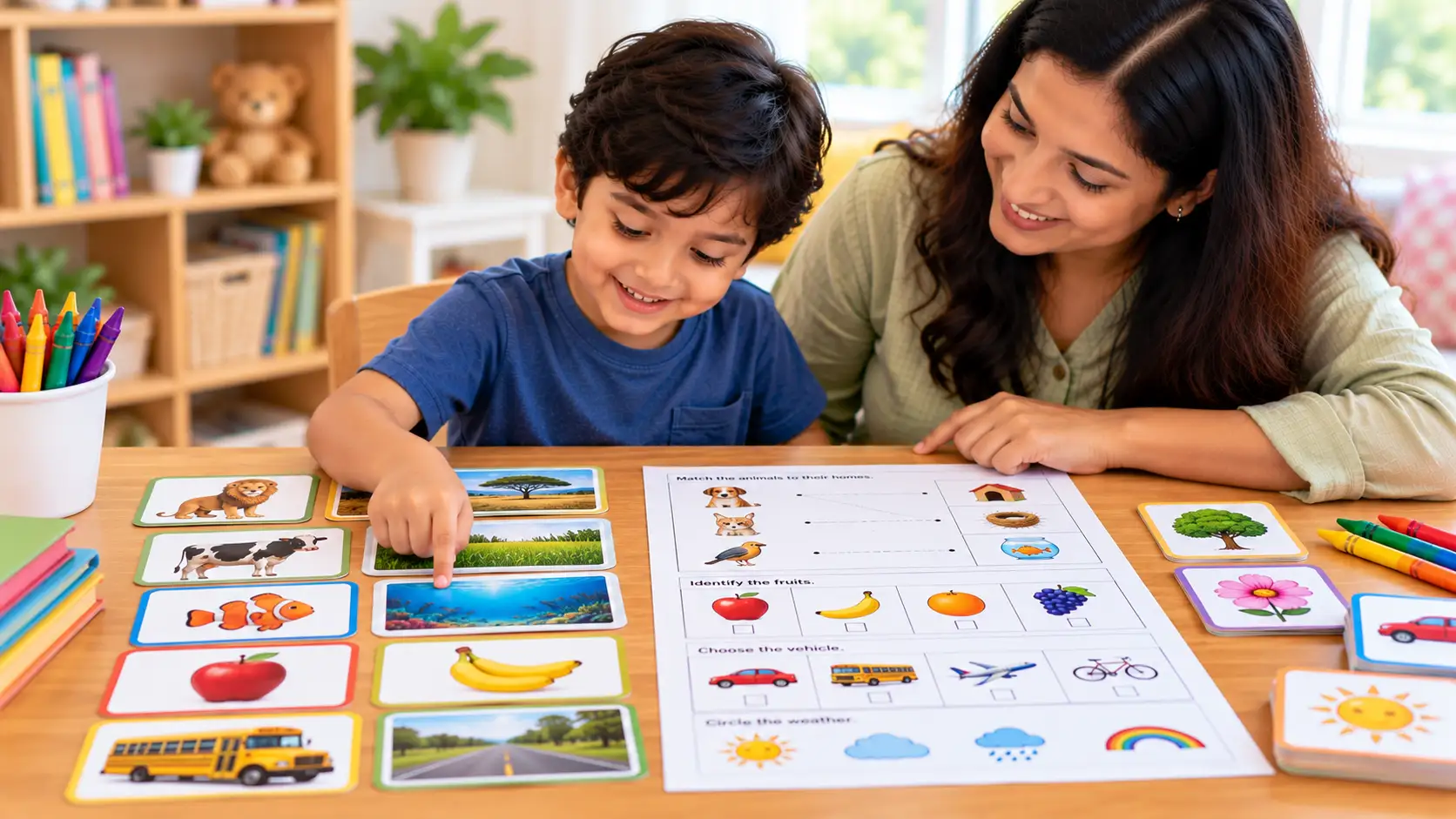
Children are naturally curious about the world around them. They want to know why birds fly, where fruits grow, how vehicles move and why the weather changes. These everyday questions create wonderful opportunities for learning.
General knowledge activities help kindergarten children explore familiar topics, develop observation skills and build their understanding of the world. Through pictures, simple questions, matching games and everyday conversations, children can learn new facts while having fun.
The good news is that general knowledge practice doesn't need to feel like a classroom lesson. Parents can introduce simple activities during playtime, storytime, outdoor walks and everyday routines.
In this guide, we'll explore 12 fun general knowledge activities for kindergarten, covering animals, fruits, vegetables, colours, body parts, transport, seasons and more. You'll also discover how printable kindergarten general knowledge worksheets can support learning at home.
What Is General Knowledge for Kindergarten?
General knowledge for kindergarten introduces children to basic information about their surroundings, everyday objects, nature and the world they live in.
At this age, children learn best through familiar examples, pictures, conversations and hands-on activities.
Common general knowledge topics for kindergarten include:
-
Animals and birds: Their names, sounds, habitats and food.
-
Fruits and vegetables: Identifying common foods and understanding where they come from.
-
Colours and shapes: Recognising colours, shapes and patterns.
-
Body parts and senses: Learning about the human body and the five senses.
-
Transport: Identifying vehicles used on roads, in the air and on water.
-
Plants and nature: Learning about trees, flowers, weather and seasons.
-
Community helpers: Understanding the roles of doctors, teachers, firefighters and other helpers.
-
Everyday life: Recognising household objects, clothing, food and common places.
The goal isn't to memorise long lists of facts. It is to help children notice things, ask questions and make connections between what they learn and what they experience every day.
Why Are General Knowledge Activities Important for Kindergarten Children?
General knowledge activities support several areas of early learning.
1. Build curiosity about the world
Children learn to observe their surroundings and ask questions about familiar people, animals, objects and events.
2. Develop vocabulary
Learning the names of animals, plants, vehicles and everyday objects helps children communicate more confidently.
3. Improve observation skills
Picture-based games and matching activities encourage children to notice details and identify similarities and differences.
4. Support early thinking skills
Simple questions such as “Which animal lives in water?” encourage children to recall information and think about what they know.
5. Encourage conversations
Discussing everyday topics gives children opportunities to describe objects, explain their choices and ask questions.
6. Prepare children for classroom learning
Familiarity with common topics can help children participate in discussions, picture-based exercises and early learning activities.
Children don't need to know every answer. Encourage curiosity, explain unfamiliar concepts and let learning develop through everyday experiences.
12 Fun General Knowledge Activities for Kindergarten
These activities are easy to try at home or in the classroom. Most require only picture cards, common objects, simple questions or printable worksheets.
1. Match Animals with Their Homes
Children often enjoy learning about animals and where they live. This activity helps them connect familiar animals with suitable habitats.
What you need: Animal picture cards and pictures of different habitats.
How to play:
-
Show your child pictures of a fish, bird, rabbit and lion.
-
Place pictures of water, a nest, a rabbit hutch and a grassland habitat on the table.
-
Ask your child to match each animal with a suitable home.
-
Talk about how each animal lives in its environment.
Explain that different animals have different needs. A fish lives in water, many birds build nests, and lions live in habitats such as grasslands and savannas.
You can make the game more challenging by adding animals that live in forests, deserts or polar regions.
Learning benefit: Introduces animal knowledge, habitats and basic classification.
2. Identify Fruits and Vegetables
Fruits and vegetables are familiar parts of everyday life, making them useful for general knowledge practice.
What you need: Real food items, toy food or picture cards.
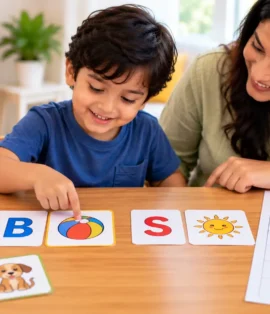
Show your child pictures of an apple, banana, carrot, tomato, potato and cucumber.
Ask them to name each item and identify whether it is commonly eaten as a fruit or vegetable in everyday cooking.
You can also ask simple questions:
-
Which fruit is yellow?
-
Which vegetable is orange?
-
Which foods have seeds?
-
Which foods do we use in a salad?
Let your child explore real fruits and vegetables when possible, observing their colours, shapes and textures.
Learning benefit: Builds food vocabulary, observation skills and familiarity with everyday foods.
3. Play a Colours and Objects Game
This activity combines colour recognition with general awareness.
What you need: Colour cards and everyday objects.
Choose a colour and ask your child to find an object that matches it.
For example, ask them to find something red, such as an apple or a red toy car.
You can reverse the activity by showing an object and asking your child to name its colour.
For an extra challenge, ask children to identify several objects of the same colour around the room.
Learning benefit: Reinforces colour recognition, observation and vocabulary.
4. Learn About Body Parts and the Five Senses
Children can develop general awareness by learning about their bodies and how they experience the world.
What you need: A simple body diagram or picture cards showing the five senses.
Point to common body parts such as the eyes, ears, nose, mouth, hands and feet.
Explain how different senses help us:
-
Eyes help us see.
-
Ears help us hear.
-
The nose helps us smell.
-
The tongue helps us taste.
-
The skin helps us feel touch.
Turn the lesson into a guessing game. Ask, “Which body part helps us hear music?” or “Which sense helps us smell a flower?”
Learning benefit: Builds body awareness, vocabulary and understanding of everyday experiences.
5. Explore Different Types of Transport
Children see vehicles on roads, in the sky and on water. These make excellent examples for a general knowledge activity.
What you need: Transport picture cards or toy vehicles.
Show your child pictures of a car, bus, bicycle, aeroplane, boat and train.
Ask them to identify each vehicle and group it according to where it travels.
For example:
-
Road: Car, bus and bicycle.
-
Railways: Train.
-
Air: Aeroplane.
-
Water: Boat.
Discuss how each vehicle helps people travel or transport goods.
Learning benefit: Develops classification skills and introduces children to different forms of transportation.
6. Discover Community Helpers
Community helpers are people who provide services that help others in everyday life.
What you need: Picture cards showing different occupations.
Introduce familiar roles such as doctors, teachers, firefighters, farmers, police officers and postal workers.
Ask your child to match each person with the work they do.
For example, a doctor helps care for people who are unwell, a teacher helps children learn, and a farmer grows crops or raises animals.
You can extend the activity by asking children which community helpers they have seen in their neighbourhood.
Learning benefit: Builds social awareness and helps children understand the roles people play in a community.
7. Learn About Seasons and Weather
Weather provides a simple way to introduce children to changes in their environment.
What you need: Pictures showing sunny, rainy, cloudy and windy weather.
Show your child each picture and ask them to describe what they see.
Talk about familiar experiences, such as using an umbrella when it rains or wearing warm clothes in cold weather.
You can also discuss seasonal changes, including warmer or cooler days, changes in plants and different activities people enjoy throughout the year.
Remember that seasons vary by region. Use examples that reflect the weather your child experiences locally.
Learning benefit: Encourages observation, descriptive language and awareness of nature.
8. Match Objects with Their Uses
Children learn about the world by discovering how everyday objects are used.
What you need: Household object cards or a collection of safe, familiar items.
Show your child pictures of a toothbrush, spoon, umbrella, comb and school bag.
Ask them to explain what each object is used for.
You can make the activity into a matching game by pairing objects with pictures of their uses.
For example, match a toothbrush with brushing teeth and an umbrella with protection from rain.
Learning benefit: Builds practical knowledge, vocabulary and connections between objects and their purposes.
9. Explore Plants and Nature
Nature activities help children learn about living things and their surroundings.
What you need: Pictures of plants, flowers, trees and seeds, or a chance to observe plants outdoors.
Show your child pictures of a tree, flower, leaf, seed and fruit.
Explain that plants need suitable conditions, including water, light and air, to grow.
If possible, let your child observe a plant in a garden or pot. Ask them to notice its leaves, stem and flowers.
You can also encourage children to compare different leaves or identify plants they see during a walk with an adult.
Learning benefit: Introduces basic plant knowledge, observation and care for the natural environment.
10. Play a Healthy Habits Sorting Game
General knowledge can also help children understand everyday routines that support wellbeing.
What you need: Picture cards showing daily habits.
Include pictures of brushing teeth, washing hands, eating a variety of foods, drinking water, playing outdoors and sleeping.
Ask your child to group the pictures into habits that help keep the body clean, support healthy routines or provide opportunities for movement and rest.
Discuss why washing hands before eating and brushing teeth regularly are useful habits.
Keep the explanations positive and age-appropriate rather than making children feel worried about everyday mistakes.
Learning benefit: Supports everyday awareness and introduces simple self-care routines.
11. Try a Picture-Based General Knowledge Quiz
A simple quiz can help children recall facts they've learned through play.
What you need: Picture cards or a general knowledge worksheet.
Ask short, clear questions such as:
-
Which animal says “meow”?
-
Which vehicle travels on railway tracks?
-
What do plants need to grow?
-
Which body part helps us see?
-
Which fruit is commonly yellow when ripe?
Show picture choices when needed so children can answer by pointing.
Celebrate correct answers and use incorrect answers as opportunities to explain the topic.
You can also let your child ask you questions, turning the quiz into a two-way conversation.
Learning benefit: Encourages recall, listening and confidence when answering questions.
12. Practise with Printable Kindergarten General Knowledge Worksheets
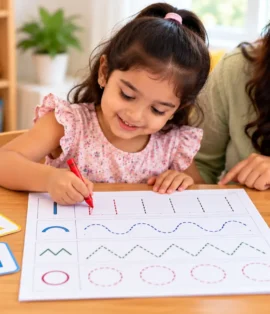
After exploring topics through conversations and games, worksheets can provide a simple way to revisit what children have learned.
Look for kindergarten general knowledge worksheets with clear pictures, short instructions and familiar topics.
Useful worksheet activities include:
-
Animal matching: Match animals with their homes or foods.
-
Picture identification: Identify fruits, vegetables, birds and vehicles.
-
Community helpers: Match people with their occupations.
-
Body parts: Label or identify common body parts using pictures.
-
Transport sorting: Group vehicles by where they travel.
-
Nature activities: Identify plants, weather conditions and natural objects.
-
Everyday objects: Match household items with their uses.
-
Simple GK questions: Choose the correct answer from picture options.
Start with topics your child already recognises and gradually introduce new information.
Explore Kids Easy Learning's general knowledge worksheets for printable learning resources to support general awareness practice at home.
For the best results, discuss the pictures with your child instead of simply asking them to complete the page. A short conversation about each answer can make the activity more meaningful.
How to Teach General Knowledge to Kindergarten Children
Young children learn best when new information connects with things they already know.
Here are a few ways to make general knowledge practice more effective.
Start with familiar topics. Begin with animals, food, body parts and objects your child sees regularly.
Use pictures and real objects. Visual examples make unfamiliar concepts easier to understand.
Ask simple questions. Questions such as “Where does a fish live?” encourage children to recall and explain what they know.
Connect learning with everyday experiences. Talk about transport while travelling, plants during a walk or fruits while preparing a meal.
Repeat information naturally. Revisit familiar topics through different games rather than expecting children to remember everything immediately.
Encourage questions. If your child asks why something happens, explore the answer together using age-appropriate explanations.
Use worksheets as reinforcement. Printable activities can help children revisit concepts introduced through play and conversation.
The goal is to develop curiosity and understanding, not to turn general knowledge into a memorisation test.
General Knowledge Topics Kindergarten Children Can Explore
You can organise general knowledge practice into small topic groups so that children gradually explore different areas.
| Topic | Examples to learn | Suggested activity |
|---|---|---|
| Animals and birds | Names, sounds and habitats | Match animals with pictures |
| Fruits and vegetables | Names, colours and uses | Identify real foods |
| Body parts | Eyes, ears, nose and hands | Picture identification |
| Transport | Cars, buses, trains and boats | Sort vehicles |
| Community helpers | Doctors, teachers and farmers | Match people with jobs |
| Plants and nature | Trees, flowers and leaves | Nature observation |
| Weather and seasons | Sunny, rainy and cloudy days | Weather picture matching |
| Everyday objects | Books, spoons and umbrellas | Match objects with uses |
| Healthy habits | Handwashing and brushing teeth | Sort routine pictures |
| Colours and shapes | Basic colours and geometric shapes | Find matching objects |
Use this table as a flexible learning guide. You don't need to cover every topic in one session.
How to Make General Knowledge Learning Fun at Home
General knowledge doesn't have to be a separate activity on your child's schedule. Small conversations and playful questions can introduce new information throughout the day.
Try these simple ideas:
-
Ask your child to identify three animals in a picture book.
-
Talk about the vehicles you see during a walk.
-
Invite your child to help identify fruits and vegetables while shopping.
-
Observe the weather together and describe what you see.
-
Discuss the jobs of people who help your family or neighbourhood.
-
Use picture cards for a short question-and-answer game.
-
Choose a printable GK worksheet related to a topic your child enjoys.
Keep activities short and adjust the difficulty according to your child's interest. Some children enjoy answering questions, while others learn more comfortably through matching, drawing or pointing to pictures.
Common Mistakes to Avoid When Teaching General Knowledge
A few simple changes can make general knowledge activities more useful for young children.
Teaching too many facts at once: Focus on a small topic and revisit it before introducing lots of new information.
Relying only on memorisation: Encourage children to understand and discuss what they see rather than simply repeat answers.
Using unfamiliar examples: Start with familiar objects and experiences before exploring less common topics.
Making every activity a quiz: Include conversations, games, picture books and hands-on experiences.
Expecting every answer to be correct: Gently explain unfamiliar concepts and give children another opportunity to try.
Using worksheets without discussion: Talk about the pictures and ask follow-up questions to deepen understanding.
Treating general knowledge as a competition: Every child learns at a different pace. Focus on curiosity and progress rather than comparing children.
Frequently Asked Questions
Kindergarten children can explore animals, birds, fruits, vegetables, colours, shapes, body parts, transport, community helpers, plants, weather and everyday objects. Activities should use familiar examples and simple explanations suited to their age.
Talk about everyday experiences, read picture books, play matching games and ask simple questions about familiar objects. Outdoor walks, mealtimes and travel can all become opportunities to explore the world together.
Yes. Age-appropriate GK worksheets help children identify pictures, match related objects, recall basic facts and practise what they have learned. They are most useful when combined with conversation, hands-on activities and real-world experiences.
You can ask questions such as “Which animal says meow?”, “What do we use an umbrella for?”, “Which body part helps us see?” and “Which vehicle travels on water?” Use familiar examples and picture choices to make answering easier.
General knowledge can be included in everyday conversations and short learning activities. A few minutes of picture matching, storytelling or a simple worksheet can be enough for one session. Adjust the activity according to your child's interest and attention.
General knowledge introduces children to everyday facts about people, nature, objects and their surroundings. Academic learning includes more structured skills such as reading, writing and maths. Both can complement each other through age-appropriate activities and playful learning.
Explore General Knowledge Worksheets with Kids Easy Learning
Children learn about the world through questions, conversations, observation and play. From recognising animals and vehicles to understanding weather and everyday objects, simple general knowledge activities can make learning part of daily life.
Start with topics your child enjoys, use pictures and real-world examples, and encourage them to ask questions.
When your child is ready for additional practice, printable kindergarten general knowledge worksheets can help reinforce familiar concepts and introduce new ones.
Explore Kids Easy Learning for printable educational resources that make early learning engaging, practical and fun for little learners.