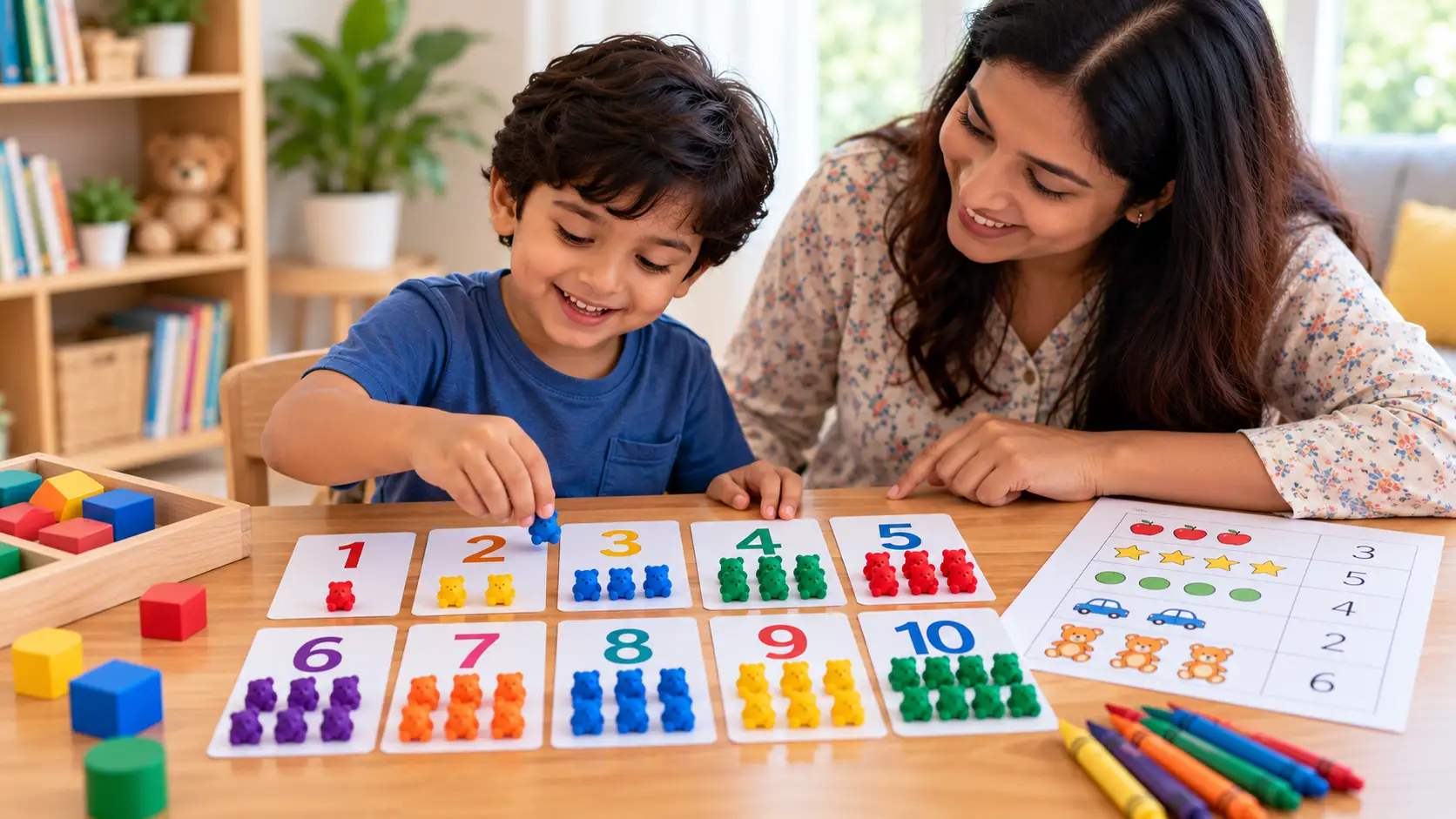
Learning to count is one of the first steps in a child's maths journey. From counting toys and snacks to recognising numbers on a page, children discover maths through the little things they do every day.
For kindergarten children, counting becomes easier when they can touch, move, group and see the objects they are learning about. Instead of relying only on number songs or worksheets, parents can introduce simple games that make counting a natural part of everyday life.
The good news is that you don't need expensive toys or special learning equipment. With a few household objects and some playful ideas, you can create plenty of opportunities for your child to practise counting.
In this guide, we'll explore 12 fun counting activities for kindergarten that you can try at home, along with practical tips to help your child develop confidence in early maths.
Why Are Counting Activities Important for Kindergarten Children?
Counting involves more than memorising numbers in the correct order. Children gradually learn to connect number words with quantities and understand how numbers work together.
Regular counting activities help children develop several important skills.
1. Understanding numbers and quantities
Children learn that numbers represent how many objects are in a group. Counting four blocks, for example, helps them understand what the number 4 means.
2. Developing one-to-one correspondence
This means understanding that each object should be counted once. Touching each toy while saying a number helps children develop this skill.
3. Recognising number patterns
As children practise counting, they begin to notice number sequences and understand which numbers come before or after others.
4. Preparing for addition and subtraction
Counting objects, adding another item to a group and taking objects away introduce the basic ideas behind simple maths operations.
5. Building confidence in maths
Play-based activities give children opportunities to practise without feeling pressured to get every answer right immediately.
12 Fun Counting Activities for Kindergarten
These activities use everyday materials and can be adapted to suit your child's learning level. Start with small quantities and gradually increase the difficulty as your child becomes more comfortable.
1. Count Toys and Building Blocks
Building blocks, toy cars and animal figures are excellent tools for practising counting.
What you need: A collection of small toys or building blocks.
How to play:
-
Place five toys in front of your child.
-
Ask them to touch each toy while counting aloud.
-
Ask how many toys there are altogether.
-
Add another toy and count the group again.
Start with three to five objects if your child is still learning. Gradually introduce larger groups as their counting becomes more accurate.
Learning benefit: Helps children connect number words with actual quantities and practise counting each object once.
2. Count Snacks During Mealtime
Mealtimes offer an easy opportunity to introduce counting into everyday routines.
Place a few pieces of fruit, crackers or other age-appropriate snacks on your child's plate. Ask them to count the pieces before eating.
You can try simple questions such as:
-
How many apple slices are on your plate?
-
Can you count three crackers?
-
If you have two grapes and I give you one more, how many do you have?
Keep the activity relaxed and supervise children appropriately when eating. Avoid small or hard foods that could present a choking risk.
Learning benefit: Makes counting relevant to real-life situations and introduces simple quantity comparisons.
3. Play a Number Card Counting Game
Number cards can help children connect written numerals with the quantities they represent.
What you need: Number cards from 1 to 10 and small counting objects.
Place the number cards face up on a table. Ask your child to choose a card and place the corresponding number of objects beside it.
For example, if your child selects the number 6, they should count out six blocks.
You can reverse the activity by placing a group of objects on the table and asking your child to find the matching number card.
Learning benefit: Connects number recognition with counting and quantity understanding.
4. Go on a Counting Hunt Around the House
Turn an ordinary walk around your home into a counting game.
Choose a category of objects and ask your child to find and count them. You could look for books on a shelf, cushions in a room, chairs around a table or plants on a balcony.
Try questions such as:
-
How many books can you see?
-
Can you find four cushions?
-
How many chairs are around the table?
Let your child point to each object while counting to avoid counting the same item twice.
Learning benefit: Encourages observation and shows children that maths is part of their surroundings.
5. Sort and Count Colourful Objects
Sorting combines counting with an introduction to grouping and classification.
What you need: Colourful blocks, large buttons, toy animals or coloured pencils.
Ask your child to sort the objects by colour, shape or type. Then count how many objects belong to each group.
For example, if there are four red blocks and three blue blocks, ask your child how many blocks are in each group.
For an extra challenge, ask which group has more and which has fewer.
Learning benefit: Develops counting accuracy, comparison skills and early mathematical reasoning.
6. Count While Clapping, Jumping or Hopping
Some children enjoy movement-based learning more than sitting at a table. This activity combines physical movement with number practice.
Ask your child to clap five times, jump three times or hop four times while counting aloud.
You can also call out a number and ask them to perform the action that many times.
For example, say, “Let's do seven claps together!”
Begin with small numbers and increase the count as your child becomes more confident. Provide enough space and supervise movement.
Learning benefit: Reinforces number sequences and gives children an active way to practise counting.
7. Make a Counting Tray
A counting tray is a simple hands-on activity that can be reused with different objects.
What you need: A tray, small bowls or containers, and safe counting objects such as large blocks.
Write numbers on small pieces of paper and place one number in each section of the tray.
Ask your child to put the matching number of objects into each section. For example, the section marked 3 should contain three blocks.
You can begin with numbers 1 to 5 and gradually extend the activity to 10.
Learning benefit: Helps children practise counting independently and match quantities with written numbers.
8. Count with Everyday Household Items
You don't need dedicated maths toys to practise counting. Many safe household items can become learning materials.
Try counting:
-
Spoons while setting the table.
-
Pairs of socks while folding laundry.
-
Pencils before starting an activity.
-
Books while organising a shelf.
-
Large toy animals during playtime.
Ask your child to count the items and tell you the total.
For children who are more confident, introduce simple comparison questions such as, “Do we have more pencils or more books?”
Learning benefit: Builds familiarity with counting in practical situations and encourages children to apply maths outside structured lessons.
9. Play a Counting Board Game
Create a simple board game using paper, a marker and a small toy as a game piece.
Draw a path with numbered spaces from 1 to 10. Ask your child to roll a large foam die or use number cards to decide how many spaces to move.
As they move, encourage them to count each space aloud.
For younger kindergarten children, use smaller numbers and a shorter path. Once they understand the game, extend the board to 20.
Learning benefit: Combines counting practice with turn-taking, number sequences and following simple rules.
10. Count with Playdough
Playdough is useful for combining creative play with early maths.
Ask your child to make small playdough balls and count them one by one. You can call out a number and ask them to make that many balls.
For example, ask them to make eight balls, count them together and then rearrange them into two groups.
You can also create simple number shapes with playdough and place the matching quantity beside each numeral.
Learning benefit: Encourages hands-on exploration and connects written numbers with quantities.
11. Practise Counting with Songs and Rhymes
Counting songs make number sequences easier to remember through repetition and rhythm.
Choose familiar songs that involve counting forwards or backwards. Encourage your child to use their fingers, clap along or count objects while singing.
You can also pause before the next number and let your child complete the sequence.
For example, count aloud together: “One, two, three, four...” and ask your child what comes next.
Remember that reciting a number sequence and accurately counting objects are different skills. Combine songs with hands-on activities so children practise both.
Learning benefit: Reinforces number order, listening and memory while keeping practice enjoyable.
12. Practise with Printable Counting Worksheets
Once your child has explored counting through play, worksheets can provide another way to practise the same skills.
Look for age-appropriate counting worksheets for kindergarten that allow children to count pictures, match quantities and identify the correct numbers.
Useful worksheet activities include:
-
Count and circle: Count a group of pictures and circle the correct numeral.
-
Count and match: Draw a line connecting a number with the matching group of objects.
-
Count and colour: Colour a specified number of objects.
-
Missing numbers: Fill in the gaps in a number sequence.
-
Number tracing: Trace numerals after counting the matching objects.
Choose worksheets that match your child's current ability. If counting to five is still difficult, begin with small groups before moving on to larger quantities.
Explore Kids Easy Learning for printable learning resources, and choose suitable maths worksheets to support your child's practice at home.
For the best results, combine worksheet activities with physical objects, games and everyday counting opportunities.
How to Teach Counting from 1 to 20
If your child is becoming comfortable counting to 10, you can gradually introduce numbers up to 20.
Here are some practical ways to build their skills.
Start with familiar numbers. Make sure your child can count small groups of objects before increasing the quantity.
Practise counting forwards. Say the numbers together and point to each number on a number line.
Use groups of objects. Ask your child to count 11 blocks, 12 crayons or 15 large toy pieces, depending on their ability.
Introduce missing numbers. Say, “Five, six, seven, what comes next?” and let your child complete the sequence.
Practise counting backwards. Once your child is comfortable counting forwards, try simple countdowns from five or ten.
Repeat without rushing. Children may need several opportunities to become comfortable with numbers beyond 10.
Remember that counting aloud to 20 does not automatically mean a child can accurately count 20 objects. Practise both skills separately and together.
Counting Skills Kindergarten Children Should Practise
Children develop at different rates, but these skills provide useful areas to practise during the kindergarten years.
| Counting skill | Example activity |
|---|---|
| Saying numbers in order | Count aloud from 1 to 10 |
| Counting objects accurately | Touch and count five blocks |
| Matching numbers with quantities | Match the number 4 with four objects |
| Identifying the total | Count a group and answer “How many?” |
| Comparing quantities | Identify which group has more objects |
| Recognising missing numbers | Complete 1, 2, __, 4 |
| Beginning to count backwards | Count down from 5 to 1 |
Use this table as a flexible guide rather than a strict checklist. Some children may be comfortable with certain skills while still practising others.
Frequently Asked Questions
Counting toys, matching number cards with objects, sorting colourful blocks, counting snacks, playing movement games and completing printable counting worksheets are useful activities for kindergarten children. Choose activities that match your child's current counting skills.
Start by counting everyday objects such as toys, books and pencils. Encourage your child to touch each object while saying the corresponding number. Introduce number cards and simple games to help them connect written numerals with quantities.
Counting expectations vary by age, experience and educational setting. Many kindergarten children practise counting to 10, 20 or beyond, but accurately counting objects is also important. Focus on steady progress rather than expecting every child to reach the same number at the same time.
Counting involves saying numbers in order and identifying how many objects are in a group. Number recognition means identifying written numerals, such as 5 or 8. Children benefit from practising both skills because they support each other.
Yes. Counting worksheets can help children practise counting pictures, matching numbers with quantities, identifying missing numbers and recognising numerals. They work best alongside hands-on activities that let children touch, move and count real objects.
Short, enjoyable sessions are a good starting point. You can include counting in everyday routines and add a brief game or worksheet when your child is interested. Adjust the length of each activity to your child's attention, confidence and learning needs.
Make Counting Fun with Kids Easy Learning
Helping children learn to count doesn't have to mean spending long hours practising numbers at a desk. Everyday activities, favourite toys, movement games and simple counting challenges can make maths part of your child's daily routine.
Start with small groups of objects, practise counting together and gradually introduce new challenges as your child becomes more confident.
When your child is ready for additional practice, printable counting and maths worksheets can reinforce the skills learned through play.
Explore Kids Easy Learning for printable learning resources that support early maths practice and make learning more enjoyable for little learners.