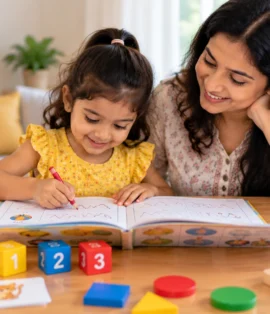
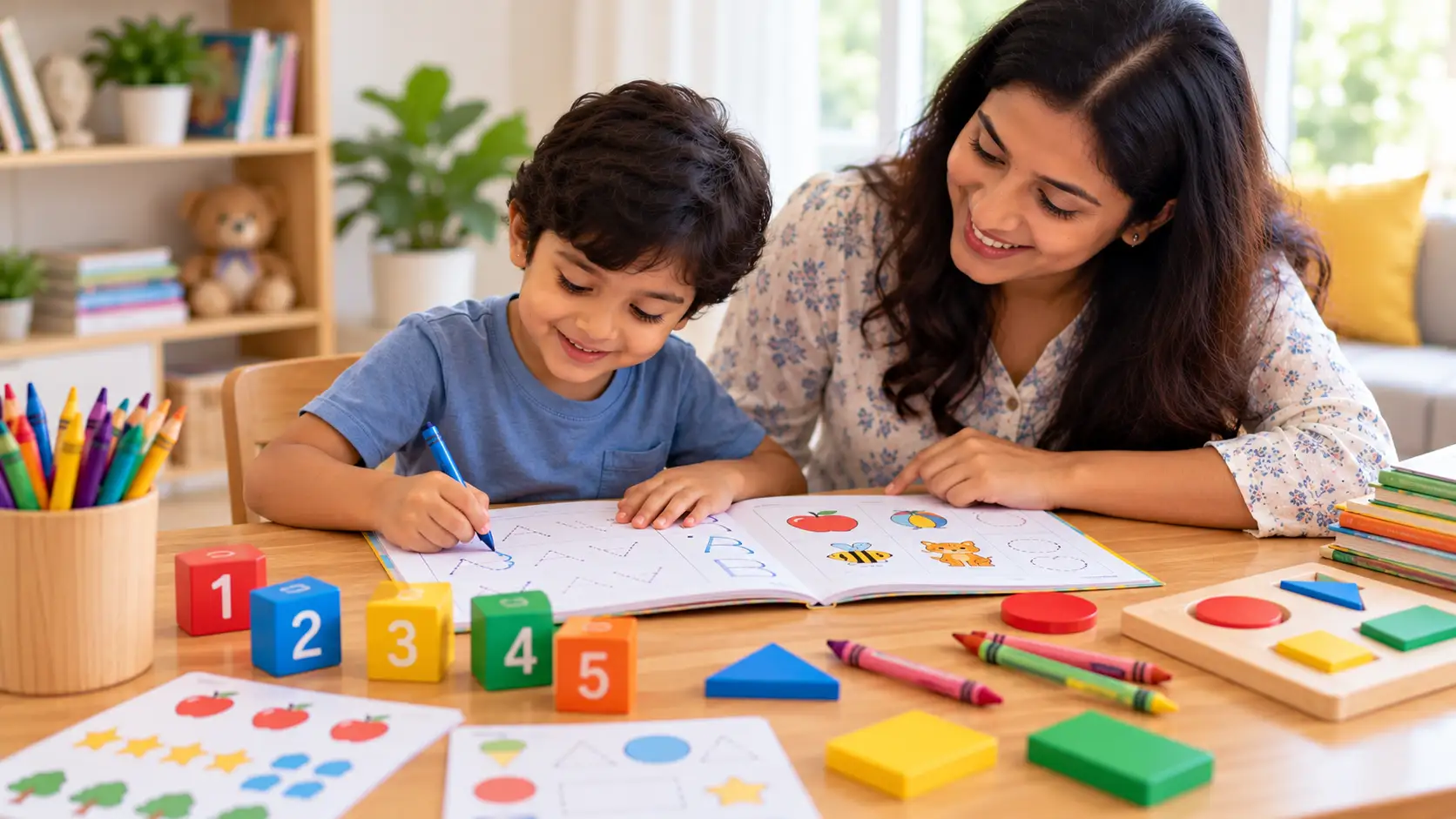
Pre-kindergarten is an exciting stage when children begin exploring letters, numbers, shapes, colors, and many other early learning concepts. They learn by asking questions, moving around, playing with objects, listening to stories, and trying things for themselves.
The good news is that pre-K learning activities don't need to be complicated. A counting game with toys, a letter hunt around the house, or a simple shape-matching activity can help children practise important skills while having fun.
Whether you're a parent planning learning activities at home or a teacher looking for ideas for the classroom, a mix of hands-on games, creative tasks, stories, and printable worksheets can make early learning more engaging.
In this guide, we'll explore practical pre-K learning activities that introduce numbers, letters, shapes, colors, patterns, and more.
What Are Pre-K Learning Activities?
Pre-K learning activities are age-appropriate experiences that help children develop foundational skills before kindergarten. They can include games, drawing, sorting, storytelling, counting, matching, movement, and simple worksheets.
These activities introduce children to concepts they may encounter in a preschool or pre-kindergarten setting.
Common learning areas include:
-
Early literacy: Letters, sounds, vocabulary, and listening.
-
Early math: Numbers, counting, quantities, shapes, and patterns.
-
Fine motor skills: Drawing, tracing, coloring, and handling learning materials.
-
Thinking skills: Matching, sorting, comparing, and solving simple problems.
-
Creative expression: Art, pretend play, music, and storytelling.
-
Social and everyday skills: Following simple instructions, taking turns, and becoming more independent.
Every child develops at a different pace. The goal is to provide enjoyable opportunities to explore these concepts rather than expecting every child to master them at the same time.
10 Fun Pre-K Learning Activities to Try
These activities use simple materials and can be adapted for different abilities. Choose a few that interest your child rather than trying to complete all of them in one session.
1. Number Recognition and Counting Games
Learning focus: Number recognition, counting, and understanding quantities.
Counting becomes more meaningful when children can connect numbers with real objects.
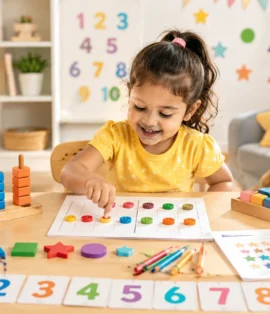
Collect a few toys, blocks, or other safe household objects. Ask your child to count them aloud while touching each item once.
Try these simple challenges:
-
Find three blocks.
-
Count five toy animals.
-
Put four crayons on the table.
-
Add one more object and count again.
-
Compare two groups to see which has more.
Start with small quantities and gradually introduce larger numbers as your child becomes comfortable.
Try this extension: Write a number on a piece of paper and ask your child to collect the same number of objects.
For additional practice, explore number worksheets for kids.
2. Alphabet Recognition and Letter Hunts
Learning focus: Letter recognition, vocabulary, and early literacy.
Turn alphabet practice into a small discovery game.
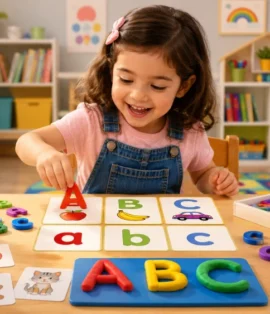
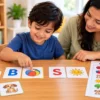
Choose one letter and write it on a card. Help your child find the same letter in a book, on a printed alphabet page, or among a few letter cards.
You can also connect letters with familiar objects. For example, B might represent a ball, and C might represent a cup.
As children become familiar with letters, introduce the sounds associated with them through simple words and pictures.
Keep the activity relaxed. Some children may enjoy recognizing uppercase letters first, while others may be ready to explore uppercase and lowercase letters together.
Try this extension: Place three letter cards on a table and ask your child to find a specific letter.
Explore alphabet worksheets for kids for more letter-recognition activities.
3. Shape Hunt Around the Home
Learning focus: Shape recognition, observation, and spatial awareness.
Children can learn about shapes by noticing them in their surroundings.
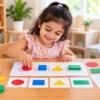
Introduce a few basic shapes, such as circles, squares, triangles, and rectangles. Show your child an example and invite them to find objects with similar shapes.
For instance:
-
Circle: A plate or clock.
-
Square: A square tile or picture.
-
Triangle: A triangular picture or shape card.
-
Rectangle: A book or door.
Once your child is comfortable identifying individual shapes, try a matching game using printed shapes and household objects.
Try this extension: Draw three different shapes on paper and ask your child to point to the matching shape when you name it.
4. Color Sorting Activities
Learning focus: Color recognition, classification, and observation.
Gather a few crayons, blocks, or other safe objects in different colors. Ask your child to group objects that share the same color.
You can make the activity more interactive by asking:
-
Can you find something red?
-
Which objects are yellow?
-
Can you put all the blue objects together?
-
Which color group has more items?
When your child is ready, introduce sorting by another feature, such as size or shape.
Let children explain their choices in their own words. This adds a language-learning element to a simple sorting game.
5. Pattern-Making with Blocks or Pictures
Learning focus: Pattern recognition, logical thinking, and early math.
Patterns help children notice what repeats and predict what comes next.
Start with a simple pattern using two colors of blocks, such as red, blue, red, blue. Ask your child which color should come next.
You can also make patterns using shapes, picture cards, or familiar objects.
For children who need more support, create a short pattern and let them copy it. As they become comfortable, leave the final position empty and ask them to complete it.
Try this extension: Clap, tap, clap, tap, and invite your child to repeat the sequence.
6. Tracing Lines and Pre-Writing Practice
Learning focus: Fine motor control, hand-eye coordination, and writing readiness.
Before children write letters and numbers independently, they benefit from practising the movements used in drawing and writing.
Offer paper, crayons, or pencils and introduce simple tracing activities:
-
Straight lines.
-
Curved lines.
-
Zigzag patterns.
-
Loops and waves.
-
Simple shapes.
Begin with easy patterns and let your child practise at a comfortable pace. Don't worry if their lines aren't perfectly accurate.
You can also create a simple path on paper and ask your child to draw along it from a starting point to a destination.
Explore tracing worksheets for additional practice.
7. Picture Matching and Memory Games
Learning focus: Visual discrimination, memory, attention, and vocabulary.
Picture-matching games encourage children to look carefully and identify similarities.
You can use picture cards, printed worksheets, or familiar objects.
For example, ask your child to match:
-
Two pictures of the same animal.
-
Objects that belong together.
-
Pictures with matching shapes.
-
Items that serve a similar purpose.
To make the game more challenging, place a few picture cards on the table, let your child study them, and then turn them over for a simple memory game.
Begin with just a few cards and add more as your child becomes comfortable.
8. Counting and Sorting Nature Objects
Learning focus: Early math, classification, and observation.
A supervised outdoor activity can combine counting with exploration.
Collect a few large, safe natural objects, such as fallen leaves or large stones, where appropriate. Ask your child to group them by size, shape, or another visible feature.
You can then count the items in each group and compare which group has more.
Ask questions such as:
-
Which leaf is bigger?
-
Can you find two leaves that look alike?
-
How many objects are in this group?
-
What differences can you see?
Use only safe materials, supervise closely, and keep small objects away from children who may put them in their mouths.
9. Storytelling and Picture Conversations
Learning focus: Language, listening, vocabulary, and imagination.
Choose a picture book and explore the illustrations with your child.
You don't always need to read the entire story from beginning to end. Pause to discuss what is happening and encourage your child to describe what they see.
Ask questions such as:
-
Who is in this picture?
-
What do you think will happen next?
-
What colors can you see?
-
Can you tell me what happened in the story?
Children can also create their own stories using toys, drawings, or picture cards.
These conversations help connect early literacy with everyday experiences.
10. Printable Worksheets and Coloring Activities
Learning focus: Reinforcing early concepts and practising hand control.
Printable worksheets can provide a simple way to revisit concepts introduced through games and hands-on activities.
Choose pages that focus on one skill at a time, such as counting, letter recognition, shape matching, or coloring.
Before asking your child to complete a page, explain the instructions and demonstrate one example if needed. Allow them to try independently when they feel comfortable.
For variety, alternate worksheet time with a movement game, story, or practical activity.
Browse the preschool worksheets collection to find learning resources that may suit your child's needs.
Pre-K Learning Activities by Skill
If you're planning a learning session, it helps to choose an activity based on the skill you want to introduce or practise.
| Learning skill | Activity idea | Materials |
|---|---|---|
| Number recognition | Match number cards with groups of objects | Number cards and blocks |
| Alphabet recognition | Find a selected letter in a book | Letter cards or books |
| Shape recognition | Match shapes with household objects | Shape cards and safe objects |
| Color recognition | Sort objects by color | Crayons or colored blocks |
| Patterns | Complete a repeating color sequence | Blocks or picture cards |
| Fine motor skills | Trace lines and simple shapes | Paper and crayons |
| Vocabulary | Describe pictures and tell stories | Picture books |
| Problem-solving | Match related pictures | Picture cards or worksheets |
| Observation | Sort leaves or other safe objects | Collected natural objects |
| Creative expression | Color or draw a familiar object | Paper and coloring materials |
You can reuse the same materials in different ways. For example, blocks can support counting, color sorting, pattern-making, and simple construction activities.
A Simple Weekly Pre-K Learning Plan
You don't need a complicated timetable to introduce early learning concepts. A flexible weekly plan can help parents and teachers rotate activities while leaving plenty of time for play.
| Day | Learning focus | Suggested activity |
|---|---|---|
| Monday | Letters | Letter hunt and alphabet picture matching |
| Tuesday | Numbers | Count toys and match quantities |
| Wednesday | Shapes and colors | Shape hunt and color sorting |
| Thursday | Fine motor skills | Drawing, tracing, or coloring |
| Friday | Patterns and thinking | Complete a simple sequence or matching game |
| Saturday | Language | Read a picture book and tell a story |
| Sunday | Review and free play | Revisit favorite activities or explore something new |
Use this plan as a starting point, not a strict schedule. Repeat activities when your child enjoys them, and change the difficulty based on their interests and abilities.
Short sessions are often easier to manage than long periods of structured work.
How to Make Pre-K Learning Fun at Home
Children are more likely to participate when activities feel enjoyable and manageable.
Follow Your Child's Interests
If your child enjoys animals, use animal pictures for counting, matching, storytelling, and coloring. Familiar topics can make new activities easier to understand.
Use Everyday Materials
You don't need specialized equipment for every activity. Books, blocks, crayons, paper, and safe household objects can provide many learning opportunities.
Give Clear, Simple Instructions
Explain one step at a time and show an example when necessary. This helps children understand what to do without feeling overwhelmed.
Encourage Exploration
Allow your child to experiment, ask questions, and make choices. If an activity doesn't go as planned, treat it as an opportunity to explore another approach.
Mix Structured Activities with Free Play
Worksheets and guided games can be useful, but children also need time to move, imagine, build, and play independently.
Praise Effort and Curiosity
Recognize when your child tries something new, keeps practising, or solves a problem. Avoid comparing their progress with that of other children.
Printable Resources for Pre-K Learning
When children are ready for additional practice, printable worksheets can complement the activities you introduce at home or in the classroom.
Kids Easy Learning offers preschool-focused learning resources that you can explore according to your child's interests and needs.
-
Alphabet practice: Explore alphabet worksheets for kids to support letter recognition.
-
Early math: Browse number worksheets for kids for counting and number practice.
-
Writing readiness: Use tracing worksheets for lines and pre-writing activities.
-
General early learning: Visit the preschool worksheets collection for additional practice.
-
Downloadable resources: Explore the preschool and kindergarten e-books collection for available learning materials.
Choose resources that complement your child's current learning activities. One or two relevant pages can be enough for a short session.
Frequently Asked Questions
Counting games, alphabet recognition, shape hunts, color sorting, pattern-making, storytelling, tracing, and picture matching are useful starting points. Choose activities that match the child's interests and current abilities.
Children can gradually develop familiarity with letters, numbers, shapes, colors, stories, simple instructions, and everyday problem-solving. School expectations vary, and children develop at different rates, so these skills should not be treated as a rigid checklist.
Use toys, blocks, books, or everyday objects to practise counting. Ask your child to count small groups, match quantities to number cards, and compare which group has more objects.
Try letter hunts, picture matching, alphabet songs, and simple games that connect letters with familiar objects. Keep sessions short and introduce letters gradually.
Yes. Age-appropriate worksheets can reinforce number recognition, letter identification, tracing, shapes, and visual matching. They work best alongside hands-on activities, reading, conversation, and free play.
There is no single ideal duration for every child. Start with short activities and adjust according to interest and attention. Allow breaks and change activities when a child becomes tired or frustrated.
You can explore the Kids Easy Learning preschool worksheets collection for available printable resources, along with the preschool and kindergarten e-books page.
Final Thoughts
Pre-K learning activities help children explore early concepts through everyday experiences, playful challenges, and creative discovery.
Counting toys, finding letters, sorting colors, identifying shapes, and completing simple worksheets can all contribute to a varied learning routine. The important thing is to choose activities that suit your child's abilities and make room for curiosity, movement, and free play.
Start with one activity, see what interests your child, and build from there.
Looking for more ideas and printable resources? Explore the Kids Easy Learning preschool worksheets collection to support your child's early learning journey.