Key Highlights
- Fun alphabet activities help preschoolers recognize and remember letters.
- Hands-on games make letter learning more enjoyable.
- Matching activities help children connect uppercase and lowercase letters.
- Sensory activities can improve letter recognition and fine motor skills.
- Alphabet crafts encourage creativity while practicing letters.
- Short, playful sessions work better than long lessons.
- Parents and teachers can use simple household materials for alphabet learning.
Best Alphabet Activities for Preschoolers
Why Alphabet Activities Are Important for Preschoolers
Alphabet activities give children repeated opportunities to recognize letters and become familiar with their shapes and sounds.
Regular playful practice can help children develop:
- Letter recognition
- Early phonics awareness
- Vocabulary
- Memory
- Listening skills
- Fine motor skills
- Hand-eye coordination
- Early reading confidence
Children also learn better when they are actively involved.
Instead of simply showing a letter and asking a child to memorize it, let them find it, touch it, build it, draw it, match it, and use it in a game.
That makes alphabet learning more meaningful.
1. Alphabet Treasure Hunt
An alphabet treasure hunt is one of the easiest activities to set up.
Write several letters on small pieces of paper and hide them around a room.
Then give your child a simple challenge:
“Can you find the letter B?”
When they find it, ask them to say the letter name.
For older preschoolers, you can make the activity slightly more challenging by asking:
“What sound does B make?”
You can also ask children to find an object that starts with the same sound.
What Children Learn
- Letter recognition
- Listening
- Observation
- Letter-sound awareness
- Problem-solving
Keep the activity short and celebrate every successful discovery.
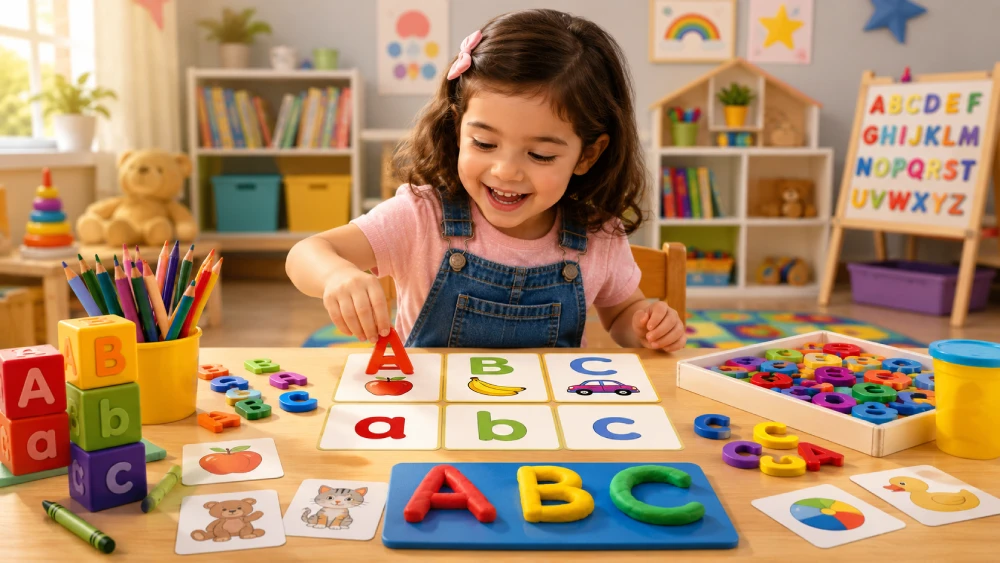
2. Alphabet Matching Game
Matching is a wonderful way to help preschoolers recognize relationships between letters.
Create cards containing uppercase and lowercase letters.
For example:
A → a
B → b
C → c
Mix the cards together and ask your child to find the matching pairs.
You can also make the activity more interesting by matching:
- Letters with pictures
- Letters with beginning sounds
- Uppercase and lowercase letters
- Letters with familiar objects
Make It More Challenging
Once your child understands basic matching, place several cards face down and turn the activity into a memory game.
For another hands-on option, children can practice with our alphabet matching game, which helps them connect uppercase and lowercase letters through play.
3. Make Letters With Playdough
Playdough is excellent for hands-on alphabet learning.
Ask your child to roll small pieces of playdough and use them to create different letters.
Start with letters your child already recognizes.
For example:
A → B → C
As they build each letter, say its name together.
Benefits of Playdough Letter Activities
- Strengthens fingers
- Develops fine motor skills
- Improves hand coordination
- Builds letter recognition
- Supports pre-writing skills
- Encourages creativity
You can also ask children to decorate their letters with small beads, buttons, or other safe craft materials.
4. Alphabet Coloring Activity
Young children usually enjoy coloring, so why not combine it with alphabet learning?
Give your child a large letter and ask them to color it.
For example:
Color the letter A.
Then show a few pictures of objects that begin with A, such as:
- Apple
- Ant
- Airplane
Ask your child to identify the letter and the pictures.
This turns a simple coloring activity into a small language-learning lesson.
Parent Tip
Do not worry about staying inside the lines.
At the preschool stage, the goal is to encourage creativity while helping children become familiar with letters.
5. Letter Sound Picture Hunt
Alphabet learning becomes more useful when children begin connecting letters with sounds.
Choose one letter.
For example:
S
Ask your child to find pictures or objects that begin with the /s/ sound.
You could use:
- Sock
- Spoon
- Soap
- Shoe
Say the words slowly and emphasize the beginning sound.
Sss-ock
Sss-poon
This helps children hear the connection between letters and sounds.
Keep It Simple
Do not introduce too many sounds at once.
One or two sounds during a short activity can be enough for a young learner.
6. Alphabet Sensory Tray
Sensory activities allow children to learn through touch and movement.
Fill a shallow tray with:
- Rice
- Sand
- Flour
- Salt
Ask your child to use a finger to trace a letter in the tray.
For example:
A
Then ask them to say the letter while tracing it.
Skills Developed
- Letter formation
- Fine motor control
- Sensory awareness
- Letter recognition
- Pre-writing readiness
You can make this activity more exciting by hiding small letter cards underneath the sensory material.
When children discover a card, ask them to identify the letter.
7. Alphabet Letter Hop Game
Preschoolers love movement, and movement can make learning more memorable.
Place large paper letters on the floor.
Call out a letter and ask your child to jump onto it.
For example:
“Jump to M!”
Then:
“Find A!”
For children who are ready for sounds, you can say the sound instead of the letter name.
This Activity Supports
- Letter recognition
- Listening
- Gross motor development
- Concentration
- Following instructions
You can also turn it into a simple alphabet race for two or more children.
8. Alphabet Craft Activities
Craft activities give children another way to interact with letters.
Try simple projects such as:
Paper Plate Letters
- Cut or draw a large letter on a paper plate and let children decorate it.
Button Letters
- Draw a large letter and let children place buttons along the outline.
Cotton Ball Letters
- Create a letter outline and fill it with cotton balls.
Sticker Letters
- Give children colorful stickers and ask them to decorate a particular letter.
These activities combine alphabet practice with creativity.
9. Alphabet Songs and Movement
Songs are an easy way to introduce repeated exposure to letters and sounds.
Sing the alphabet together and add simple movements.
For example:
- Clap when you hear A
- Jump when you hear B
- Tap your knees when you hear C
- Turn around at D
You can also use simple phonics songs and nursery rhymes.
Why Music Helps
Music can make repetition feel like play rather than practice.
It also encourages children to listen, speak, move, and participate.
If your child does not want to sit and practice letters, try singing instead.
10. Alphabet Book Reading
Reading alphabet books together can create a calm learning routine.
Choose books with:
- Large letters
- Bright pictures
- Simple words
- Repetition
- Familiar objects
While reading, point to the letters and pictures.
Ask questions such as:
“Can you find the letter B?”
“What is this picture?”
“What sound does B make?”
You do not need to turn reading time into a test.
The goal is to make children comfortable around letters and books.
For additional printable learning resources, explore our free preschool learning books in PDF form, which include early learning materials for preschool and kindergarten children.
11. Alphabet Around the House
You do not need special learning materials to practice letters.
Use things you already have around the house.
Ask your child to look for letters on:
- Food packages
- Books
- Toys
- Boxes
- Signs
- Labels
For example, if your child finds the letter C on a box, ask:
“Can you find another C?”
This activity teaches children that letters are part of their everyday environment.
12. Alphabet Tracing Practice
Tracing helps children become familiar with letter shapes and movements.
Start with large uppercase letters.
Children can trace letters using:
- Crayons
- Pencils
- Finger paint
- Chalk
- Dry-erase markers
- Sand trays
Do not expect perfect writing.
At this stage, focus on helping children understand the basic shape and direction of each letter.
For additional printable practice, you can also explore our free preschool worksheets for simple learning activities.
How to Make Alphabet Activities More Effective
The activity itself is important, but how you use it matters even more.
Keep Activities Short
Preschoolers can lose interest quickly.
Try activities lasting around:
- 5 minutes
10 minutes
15 minutes
You can always stop earlier if your child becomes tired or distracted.
Repeat Activities
Children often need repeated exposure before they remember letters confidently.
You can repeat the same game using different letters or materials.
Follow Your Child's Interests
If your child loves animals, use animal pictures for alphabet games.
For example:
- A → Alligator
- B → Bear
- C → Cat
Connecting learning to something your child already loves can make activities more engaging.
Praise Effort
Instead of only praising correct answers, recognize the effort.
Try saying:
- “You worked hard to find that letter!”
- “Great job trying!”
- “I like how carefully you made your letter.”
Positive encouragement can make children more confident learners.
A Simple 20-Minute Alphabet Learning Routine
You do not need a long lesson plan.
Try this simple routine:
| Activity | Time |
|---|---|
| Alphabet Song | 5 Minutes |
| Letter Recognition Game | 5 Minutes |
| Hands-On Letter Activity | 5 Minutes |
| Story or Alphabet Book | 5 Minutes |
Some days your child may want to continue longer.
Other days they may lose interest after a few minutes.
That's okay.
The goal is to create positive learning experiences rather than force a fixed schedule.
Common Mistakes Parents Should Avoid
- Introducing many letters at once can overwhelm young learners.
- Start with a small group of letters and gradually add more.
- Children need opportunities to use letters in different ways.
- Let them touch, build, match, trace, hear, and find letters.
- Alphabet recognition comes before perfect handwriting.
- Give children time to develop the fine motor skills needed for writing.
- Constantly asking, “What letter is this?” can make children nervous.
- Turn questions into conversations and games instead.
- Every child develops at a different pace.
- One child may recognize letters quickly while another may need more repetition.
- Patience is part of the learning process.
Easy Alphabet Activities for Different Learning Styles
Every child enjoys learning differently.
For Active LearnersTry:
|
For Creative LearnersTry:
|
For Hands-On LearnersTry:
|
For Children Who Enjoy BooksTry:
|
Using different activities gives children more opportunities to discover what they enjoy.
When Should Preschoolers Start Alphabet Activities?
- Singing the alphabet
- Looking at picture books
- Identifying familiar letters
- Finding letters around the house
- Playing simple matching games


VedaPlay Toys Review (2026) | Montessori Wooden Learning Toys
August 29, 2026[…] activities. After using educational toys, children can continue building literacy skills with our Alphabet Activities for Preschoolers and Teach Alphabets to Preschool Kids […]