Learning to write letters is an exciting step in a child's early learning journey. Before preschoolers can write the alphabet independently, they need opportunities to explore letter shapes, practise pencil movements and become familiar with how each letter is formed.
The good news is that alphabet practice doesn't have to mean sitting down with a pencil and workbook every day. Children can trace letters with their fingers, draw them in sand, make them with playdough and practise writing through simple games.
These activities make learning more enjoyable while helping children develop the fine motor skills they need for early writing.
In this guide, we'll explore 12 fun alphabet tracing activities for preschoolers that you can try at home or in the classroom. You'll also find practical tips for introducing uppercase and lowercase letters and using printable A–Z worksheets to support your child's progress.
What Is Alphabet Tracing?
Alphabet tracing is an early writing activity in which children follow the outline of a letter to practise its shape and formation.
For example, a child might follow dotted lines to trace the uppercase letter A or practise forming a lowercase a using their finger before trying it with a pencil.
Tracing helps children become familiar with the lines, curves and movements involved in writing letters.
It also introduces three important skills:
-
Letter recognition: Identifying letters by their shapes and names.
-
Letter formation: Understanding how a letter is formed.
-
Fine motor control: Practising the small hand and finger movements involved in drawing and writing.
Alphabet tracing is only one part of learning to write. Children also benefit from listening to letter sounds, recognising letters in books and exploring writing through drawing and play.
Why Are Alphabet Tracing Activities Important for Preschoolers?
Regular opportunities to explore letters can help children develop the foundations for early writing.
1. Builds familiarity with the alphabet
Tracing gives children repeated opportunities to look at letters and become familiar with their shapes.
2. Develops fine motor skills
Holding crayons, moving fingers along outlines and controlling a pencil help children practise the hand movements used in early writing.
3. Introduces letter formation
Children begin learning where a letter starts, which direction the lines move and how different strokes come together.
4. Supports letter recognition
When children trace a letter while saying its name, they practise connecting its visual shape with its name.
5. Builds writing confidence
Starting with guided tracing can make independent letter writing feel more manageable as children gain experience.
Remember that children develop these skills at different rates. The goal is to give them enjoyable opportunities to practise rather than expecting perfect handwriting straight away.
12 Fun Alphabet Tracing Activities for Preschoolers
These activities use simple materials to make A–Z practice more engaging. Begin with a few familiar letters and introduce more as your child becomes comfortable.
1. Trace Letters with Fingers
Finger tracing is an easy way to introduce letter shapes before children start using pencils.
What you need: Large alphabet cards or paper with clearly printed letters.
How to play:
-
Choose a large uppercase letter, such as A.
-
Show your child the letter and say its name.
-
Demonstrate how to trace its outline with one finger.
-
Let your child follow the same path.
-
Repeat with a few familiar letters.
Once your child becomes comfortable with uppercase letters, introduce lowercase versions.
You can also use laminated letter cards so your child can practise repeatedly with a finger or a suitable dry-erase marker.
Learning benefit: Helps children become familiar with letter shapes and the movements involved in forming them.
2. Practise with Dotted Alphabet Worksheets
Dotted letter worksheets provide a clear guide for children who are beginning to practise writing.
What you need: Alphabet tracing worksheets and thick crayons or child-friendly pencils.
Choose a worksheet featuring a few large dotted letters. Show your child where to begin and demonstrate how to follow the dots.
Start with simple letters such as L, T and I before introducing letters with more complex curves and strokes.
Encourage your child to follow the letter slowly rather than rushing to finish the page.
As their control improves, introduce worksheets with smaller letters or fewer tracing guides.
Learning benefit: Supports guided letter formation and early pencil control.
3. Draw Letters in Sand
Sensory activities give children a chance to explore letter shapes without relying on paper and pencils.
What you need: A shallow tray and a small amount of clean, child-safe sand or a suitable sensory alternative.
Spread the material evenly across the tray. Show your child a letter card and ask them to recreate the letter by moving a finger through the surface.
For example, they might practise drawing a capital T using one horizontal line and one vertical line.
Let your child gently shake the tray to smooth the surface before trying another letter.
Supervise the activity and prevent children from putting the sensory material in their mouths.
Learning benefit: Combines visual letter recognition with tactile exploration and hand movements.
4. Make Letters with Playdough
Playdough can turn alphabet practice into a hands-on creative activity.
What you need: Child-safe playdough and alphabet cards.
Show your child a letter and help them roll the playdough into long pieces.
Ask them to arrange the pieces to create the letter's shape. For example, they can use two slanting pieces and one crossbar to make an uppercase A.
Compare the finished shape with the letter card and say the letter name together.
You can also ask your child to make the first letter of their name.
Learning benefit: Encourages children to explore letter shapes while practising hand coordination and visual observation.
5. Trace Letters on a Whiteboard
A small whiteboard offers a reusable surface for letter practice.
Write a large letter on the board and ask your child to trace over it with a suitable dry-erase marker.
Once they are comfortable, erase the letter and encourage them to copy it independently.
You can begin with uppercase letters and introduce lowercase versions gradually.
Keep the letters large enough for your child to use broad arm movements before moving towards smaller writing.
Learning benefit: Provides repeated practice without using large amounts of paper and helps children transition from tracing to copying.
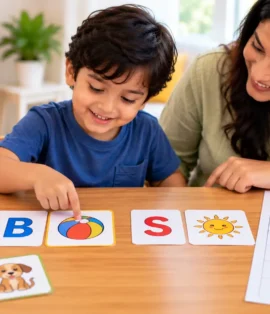
6. Match Letters with Picture Cards
Alphabet learning becomes more meaningful when children connect letters with familiar words.
What you need: Alphabet cards and picture cards featuring familiar objects.
Show your child the letter B alongside pictures of a ball, banana or bird.
Say the letter name and the beginning sound of each word. Then ask your child to trace the letter using a finger or pencil.
Repeat the activity with other familiar letters.
Remember that letter names and letter sounds are related but different skills. Introduce them together in a simple, age-appropriate way.
Learning benefit: Connects letter recognition with early phonics and vocabulary development.
7. Trace Letters on a Textured Surface
Children can explore letter shapes using surfaces that feel different from ordinary paper.
What you need: Large letter cards and a safe textured surface, such as a textured writing board.
Place a letter card in front of your child and demonstrate how to follow its outline with a finger.
Encourage them to notice where the line begins, where it turns and whether the letter includes straight lines or curves.
You can repeat the activity with several letters, allowing your child to compare their shapes.
Choose materials that are suitable for young children and avoid rough or sharp surfaces.
Learning benefit: Provides another sensory way to explore letter outlines and formation.
8. Practise the Letters in Your Child's Name
Children are often especially interested in letters that appear in their own names.
Write your child's name in large letters on a sheet of paper. Start by highlighting the first letter and explaining its name.
Invite your child to trace the letter with a finger before trying it with a crayon or pencil.
Gradually introduce the remaining letters in the name.
You can also look for the same letters in storybooks, labels or other familiar materials.
Learning benefit: Makes alphabet practice personal and helps children recognise meaningful letters.
9. Create an Alphabet Tracing Book
Turn alphabet practice into a small book that your child can revisit.
What you need: Paper, a folder or notebook, crayons and alphabet tracing pages.
Create one page for each letter or begin with a smaller collection.
Each page can include:
-
A large uppercase letter.
-
A large lowercase letter.
-
A dotted tracing outline.
-
A familiar picture beginning with the letter's sound.
-
Space for your child to draw something that starts with the letter.
Let your child colour the pictures and decorate the pages.
You don't need to complete the entire alphabet at once. Add pages gradually as your child learns new letters.
Learning benefit: Creates a familiar learning resource and provides opportunities to revisit previously practised letters.
10. Play an Alphabet Letter Hunt
Turn letter recognition into a simple search game.
Write a few letters on separate cards and place them around a safe room.
Call out a letter and ask your child to find the matching card. When they locate it, encourage them to trace the letter in the air using their finger.
You can also ask them to find the same letter on a book cover or alphabet poster.
Start with two or three letters that look noticeably different from each other.
Learning benefit: Reinforces letter identification through movement, observation and repetition.
11. Practise Uppercase and Lowercase Letter Matching
The alphabet includes uppercase and lowercase forms, and children gradually learn that the two forms represent the same letter.
Prepare matching cards showing uppercase and lowercase letters, such as A and a, B and b, and C and c.
Ask your child to match each uppercase letter with its lowercase partner.
Once they have matched a pair, invite them to trace both letters.
Some uppercase and lowercase letters look quite different, so give children time to become familiar with each pair.
Learning benefit: Builds familiarity with both forms of the alphabet and helps children recognise letters across different contexts.
12. Practise with Printable A–Z Alphabet Tracing Worksheets
After exploring letters through games and sensory activities, printable worksheets provide a useful way to practise tracing on paper.
Look for preschool alphabet worksheets with large, clear letters and simple tracing guides.
Useful worksheet activities include:
-
Uppercase letter tracing: Follow dotted capital letters from A to Z.
-
Lowercase letter tracing: Practise writing lowercase letters.
-
Letter matching: Match uppercase letters with their lowercase forms.
-
Trace and colour: Trace a letter and colour a related picture.
-
Letter and picture matching: Connect letters with familiar objects.
-
Name tracing: Practise writing the letters in a child's name.
Choose worksheets that match your child's current ability. Children who are new to writing may benefit from tracing a few large letters at a time, while more confident learners can practise several letters on a page.
Explore Kids Easy Learning for printable learning resources and suitable alphabet worksheets to support your child's A–Z practice at home.
For the best results, combine printable worksheets with finger tracing, drawing and hands-on letter games. This gives children different ways to explore the same letters without making practice repetitive.
How to Teach Alphabet Tracing from A to Z
Introducing all 26 letters at once can be overwhelming for some preschoolers. A gradual approach helps children focus on recognising and forming each letter.
Step 1: Start with a few familiar letters.
Begin with letters your child recognises, including the first letter of their name if appropriate.
Step 2: Introduce the letter shape.
Show the letter on a card or poster. Say its name and talk about whether it has straight lines, curves or both.
Step 3: Demonstrate the tracing movement.
Use your finger to show how the letter is formed. Explain the starting point and direction in simple terms.
Step 4: Practise using different materials.
Let your child trace the letter in the air, in sand, with playdough or on a reusable board before moving to a pencil and paper.
Step 5: Introduce printable worksheets.
Once your child understands the letter's shape, use a tracing worksheet for guided practice.
Step 6: Move towards independent writing.
Encourage your child to copy the letter without tracing when they are ready. Continue offering guidance when needed.
You can introduce uppercase and lowercase letters gradually. There is no need to complete every letter in a fixed timeframe.
Should Preschoolers Learn Uppercase or Lowercase Letters First?
Both uppercase and lowercase letters are important, but many early writing activities begin with uppercase letters because their shapes are often easier to distinguish and form.
A practical approach is to:
-
Introduce a few uppercase letters first.
-
Connect each letter with familiar words and pictures.
-
Show the corresponding lowercase letter.
-
Practise matching the two forms.
-
Gradually include both forms in tracing activities and reading materials.
Children will also encounter lowercase letters frequently in books and everyday writing, so it is useful to expose them to both forms as their confidence develops.
Follow your child's progress rather than expecting them to master every letter before moving on.
Common Mistakes to Avoid During Alphabet Tracing
A few simple adjustments can make letter practice more enjoyable and effective.
Starting with letters that are too small: Large letters are easier for beginners to explore with their fingers and hands.
Expecting perfect handwriting: Preschoolers are still developing the coordination needed for controlled writing. Focus on practice rather than neatness.
Using worksheets for every activity: Balance paper-based practice with drawing, sensory play and hands-on games.
Rushing through the alphabet: Learning a few letters well is more useful than completing many letters without understanding their shapes.
Ignoring letter recognition: Children benefit from seeing and naming a letter before attempting to trace it.
Forcing long practice sessions: Offer short activities and take breaks when your child loses interest.
Correcting every small mistake: Demonstrate the movement again and encourage another attempt instead of making the activity stressful.
Frequently Asked Questions
Finger tracing, dotted letter worksheets, sand tracing, playdough letters, whiteboard practice and alphabet matching games are useful activities. Combining these approaches gives children opportunities to explore letter shapes through different materials and movements.
Children can begin exploring letter shapes during the preschool years when they show interest and have opportunities for supervised mark-making. Start with large letters and finger tracing, then introduce crayons, pencils and worksheets as their hand control develops.
Many children begin with uppercase letters because their shapes can be easier to distinguish and form. However, both uppercase and lowercase letters are important. Introduce them gradually and help children understand that each uppercase letter has a corresponding lowercase form.
Show your child the letter's starting point and demonstrate the direction of each stroke. Let them trace with a finger before using a writing tool. Large letter outlines and dotted worksheets can provide useful guidance while they practise.
Yes. Age-appropriate worksheets provide guided practice with letter shapes and formation. They are most useful when combined with letter recognition, phonics, drawing and hands-on activities rather than used as the only approach to learning the alphabet.
Short, regular sessions are a good starting point. You can offer a few minutes of letter practice during daily learning time and adjust the duration according to your child's interest and attention. Revisit familiar letters while gradually introducing new ones.
Make Alphabet Learning Fun with Kids Easy Learning
Learning to write the alphabet takes time, practice and encouragement. With simple tracing games, sensory activities and age-appropriate worksheets, preschoolers can gradually become more familiar with letter shapes and the movements involved in writing.
Start with a few letters, let your child explore them through play and introduce new challenges when they are ready.
When your child wants more structured practice, printable alphabet tracing worksheets can provide a convenient way to continue learning at home.
Explore Kids Easy Learning for printable learning resources that make early education engaging and enjoyable for little learners.