Look around your home, and you'll find shapes almost everywhere. Plates are round, windows may be square or rectangular, and some rooftops form triangles. These everyday objects give children plenty of opportunities to explore shapes without needing a formal lesson.
Learning to recognise shapes is an important part of early childhood education. It helps preschoolers notice patterns, compare objects and develop the visual skills they will use in maths and other learning activities.
The best way to introduce shapes is through play. Children can sort toys, match shape cards, draw pictures, build with blocks and explore objects around them.
In this guide, we'll explore 12 fun preschool shapes activities that parents and teachers can try at home or in the classroom, along with simple tips to help children recognise basic shapes and practise what they learn.
What Are Basic Shapes for Preschoolers?
Basic shapes are simple geometric forms that children can learn to identify by looking at their appearance and features.
Preschoolers often begin with familiar two-dimensional shapes before exploring more complex shapes and three-dimensional objects.
Here are some common shapes to introduce:
-
Circle: A round shape with no corners or straight sides.
-
Square: A shape with four equal sides and four corners.
-
Triangle: A shape with three straight sides and three corners.
-
Rectangle: A shape with four corners and four sides, with opposite sides equal in length.
-
Oval: A rounded, elongated shape.
-
Diamond: A four-sided shape that looks like a diamond or a tilted square.
As children become more familiar with these shapes, you can introduce three-dimensional objects such as spheres, cubes, cones and cylinders.
Start with a few shapes at a time. Children need opportunities to see the same shape in different sizes, colours and orientations before they can reliably recognise it.
Why Are Shapes Important for Preschoolers?
Learning shapes is about more than remembering names. It helps children develop several skills that support early learning.
1. Builds early maths skills
Recognising shapes introduces children to geometry, patterns, sorting and comparing objects.
2. Develops visual observation
Children learn to notice differences and similarities in the appearance of objects, including their sides, corners and overall outlines.
3. Encourages problem-solving
Sorting shapes, completing puzzles and matching objects encourage children to think about how things fit together.
4. Supports early writing and drawing
Drawing simple shapes helps children practise hand control and become familiar with the lines and curves they will use when writing.
5. Connects learning with everyday life
When children recognise shapes in windows, plates, books and toys, they begin to understand how classroom concepts relate to the world around them.
12 Fun Preschool Shapes Activities
These activities use simple materials and playful learning methods to help children explore shapes. Adapt each activity to your child's age, interests and current skills.
1. Go on a Shape Hunt Around the House
One of the easiest ways to introduce shapes is to find them in everyday surroundings.
What you need: Household objects and a little space to explore.
How to play:
-
Choose a shape, such as a circle.
-
Ask your child to find objects that have a similar shape.
-
Look for safe examples, such as a plate, a clock face or a round coaster.
-
Repeat with squares, rectangles and triangles.
You can make the game more engaging by asking your child to explain why an object resembles a particular shape.
For example, a book cover may look like a rectangle because it has four corners and two pairs of opposite sides.
Learning benefit: Helps children recognise shapes in real-world objects rather than only on worksheets.
2. Match Shape Cards
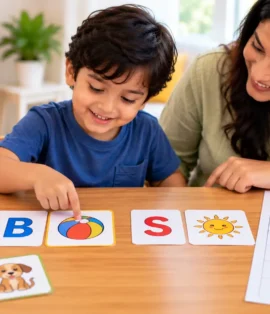
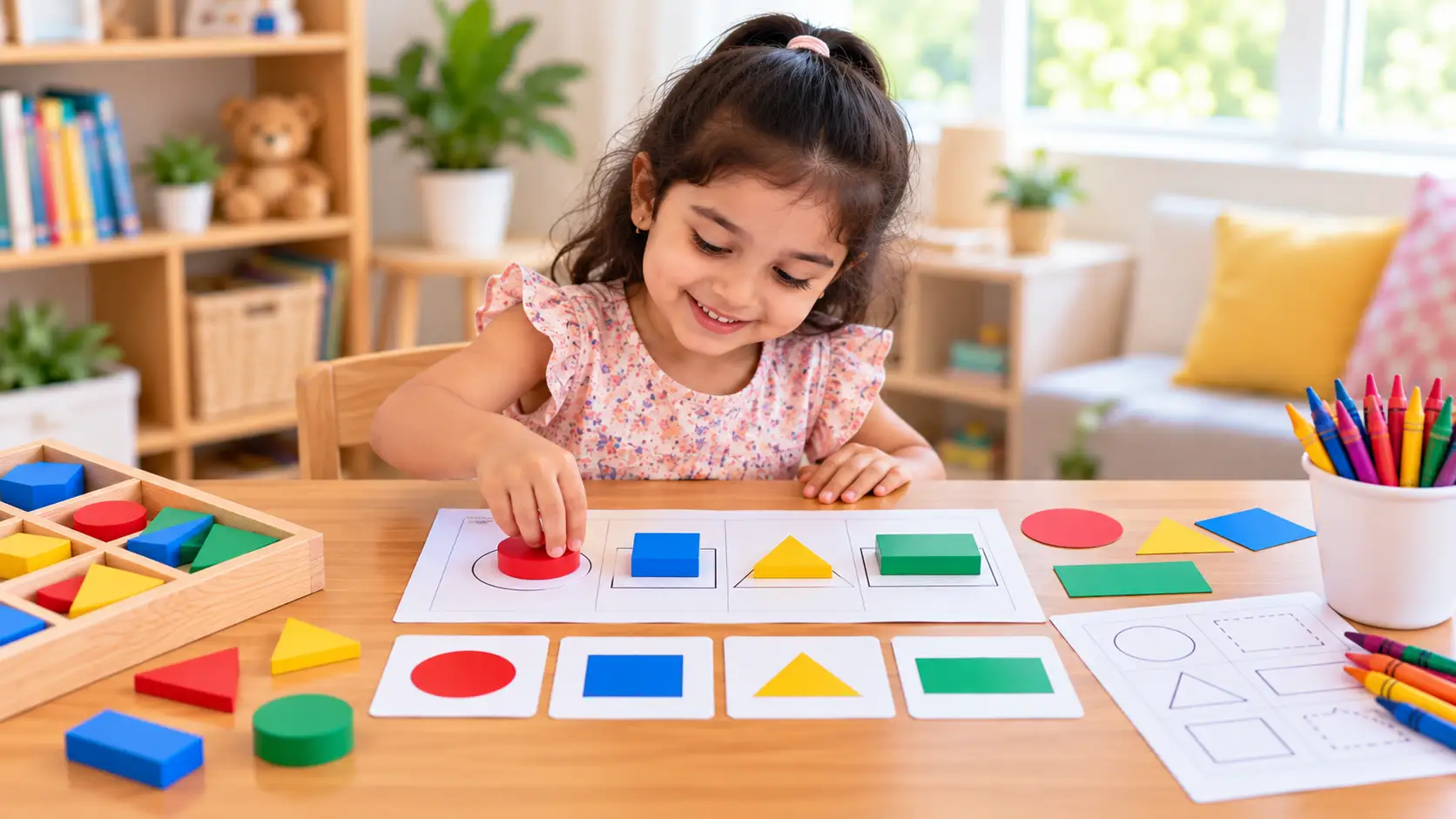
Shape matching is a simple activity for children who are just beginning to recognise basic shapes.
What you need: Shape flashcards or paper cards featuring circles, squares, triangles and rectangles.
How to play:
-
Place a few shape cards on a table.
-
Give your child a second set of matching cards.
-
Ask them to find the matching shape for each card.
-
Name each shape together as your child completes the pairs.
Begin with two or three different shapes. Add more as your child becomes comfortable.
To make the game more challenging, use shapes of different colours and sizes. This encourages children to recognise the shape itself rather than relying only on colour.
Learning benefit: Strengthens visual recognition, attention and shape vocabulary.
3. Sort Shapes by Type
Sorting helps children understand how shapes can be grouped according to their features.
What you need: Wooden shape blocks, foam shapes or paper cut-outs.
Give your child a mixed collection of shapes and ask them to place similar shapes together.
For example, all the circles can go in one group, triangles in another and squares in a third.
Once your child is comfortable, ask them to count the shapes in each group or identify which group has more.
You can also mix different colours and sizes to show that two shapes can look different but still belong to the same category.
Learning benefit: Develops classification skills, observation and early mathematical reasoning.
4. Create Pictures Using Shapes
Turn basic shapes into pictures to encourage creativity while reinforcing shape recognition.
What you need: Paper, crayons, child-safe glue and pre-cut paper shapes.
Help your child arrange shapes to make familiar pictures.
For example:
-
A house can use a square or rectangle for the building and a triangle for the roof.
-
A flower can use a circle for the centre and ovals for petals.
-
A robot can use rectangles, squares and circles.
-
A fish can be created using an oval body and triangle-shaped tail.
Ask your child to name each shape as they add it to the picture.
Adult supervision is recommended when using scissors or glue.
Learning benefit: Helps children recognise shapes, practise creativity and understand how different forms can be combined.
5. Build Shapes with Craft Sticks
Craft sticks can help children explore the sides and corners of basic shapes.
What you need: Large craft sticks or safe construction sticks.
Place three sticks on the table and help your child arrange them into a triangle. Use four equal-length sticks to create a square.
Ask questions such as:
-
How many sides does the triangle have?
-
How many corners can you see?
-
What happens when we use four sticks?
You can also compare a square with a rectangle using sticks of different lengths.
Use appropriately sized materials and supervise young children during the activity.
Learning benefit: Helps children understand the structure of shapes and count their sides and corners.
6. Trace Shapes with Fingers
Before children begin drawing shapes independently, tracing can help them become familiar with the outlines.
What you need: Large shape cards, paper or a reusable drawing board.
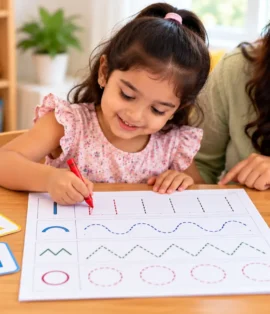
Draw a large circle, square, triangle and rectangle. Ask your child to trace each outline slowly with one finger.
Name the shape as they trace it. Encourage them to notice where the lines curve, where they turn and how many corners they can find.
You can also draw shapes in sand or use a finger to trace them on a textured surface under adult supervision.
Once your child becomes comfortable, introduce simple shape tracing worksheets.
Learning benefit: Supports shape recognition, visual tracking and early fine motor development.
7. Play a Shape Sorting Box Game
A shape sorting game gives children an opportunity to match shapes with corresponding spaces.
What you need: A shape sorter toy or a homemade sorting board with large shape outlines.
Ask your child to place each shape in its matching space. If they choose the wrong opening, encourage them to turn the piece and look at its outline again.
Talk about the features of each shape as your child plays.
For example, a triangle has three sides, while a square has four equal sides.
Choose age-appropriate toys without small detachable parts that could pose a choking hazard.
Learning benefit: Encourages visual comparison, spatial awareness and problem-solving.
8. Make Shapes with Playdough
Playdough is a fun way for children to explore shapes using their hands.
What you need: Child-safe playdough and a flat surface.
Help your child roll the playdough into long pieces and arrange them into different shapes.
They can make a triangle using three pieces, a square using four equal-length pieces, or a rectangle using two long pieces and two shorter pieces.
For circles, show your child how to roll the playdough into a ball and gently flatten it into a round shape.
Ask your child to name each shape and describe what makes it different from the others.
Learning benefit: Combines sensory exploration with shape recognition and hand coordination.
9. Find Shapes in Picture Books
Picture books often contain everyday objects that children can use to practise recognising shapes.
Choose a book with clear illustrations and ask your child to find circles, squares, triangles or rectangles on each page.
For example, they might find a round sun, a rectangular door or a triangular roof.
Encourage them to point to the object and name the shape.
You can extend the activity by asking your child to find another object with the same shape elsewhere in the room.
Learning benefit: Builds shape vocabulary, observation and connections between pictures and real-world objects.
10. Draw and Colour Different Shapes
Drawing shapes gives children an opportunity to practise recognising and creating their outlines.
What you need: Paper, crayons or washable markers.
Draw a few large shapes on paper and ask your child to name and colour them.
You can give simple instructions such as:
-
Colour the circles red.
-
Colour the squares blue.
-
Colour the triangles yellow.
-
Find and colour all the rectangles green.
For children who are ready, encourage them to draw their own shapes beside the examples.
Keep the activity flexible. The goal is to explore shapes, not to make every drawing perfectly symmetrical.
Learning benefit: Reinforces shape identification while encouraging creativity and pencil control.
11. Play a Shape Movement Game
Movement can make shape learning more enjoyable, especially for children who like active games.
Place large paper shapes on the floor with enough space between them.
Call out a shape and ask your child to walk, hop or step towards the matching card.
For example, say, “Can you find the triangle?” and let your child locate it.
You can also ask children to use their arms to make a circle or work with an adult to form a large triangle shape.
Keep the space clear and supervise movement.
Learning benefit: Reinforces shape recognition through listening, movement and repetition.
12. Practise with Printable Shapes Worksheets
Hands-on games introduce shapes in a playful way, while worksheets offer additional opportunities to recognise and practise them.
Look for preschool shapes worksheets that use clear outlines and age-appropriate activities.
Useful worksheet activities include:
-
Shape identification: Circle all the triangles or squares on a page.
-
Shape matching: Match each shape to an identical outline.
-
Shape tracing: Trace dotted outlines of circles, squares and triangles.
-
Shape colouring: Colour each shape according to simple instructions.
-
Shape sorting: Group pictures according to their shapes.
-
Complete the pattern: Identify which shape comes next in a simple sequence.
Start with a small selection of basic shapes and gradually introduce more variety.
Explore Kids Easy Learning for printable learning resources and suitable preschool maths worksheets to support your child's practice at home.
For the best results, combine worksheets with real-world shape hunts, building activities and creative play.
How to Teach Basic Shapes Step by Step
If your child is just beginning to learn shapes, introducing too many at once can make the process confusing.
Try this simple approach.
Step 1: Begin with familiar shapes.
Start with circles, squares and triangles. These shapes are easy to demonstrate using common objects.
Step 2: Show real examples.
Point out circles on plates, rectangles on books and squares on suitable tiles or picture cards.
Step 3: Talk about shape features.
Help your child notice whether a shape has straight sides, curved edges or corners.
Step 4: Practise matching and sorting.
Use shape cards, blocks or paper cut-outs to help your child identify shapes that belong together.
Step 5: Introduce drawing and tracing.
Let your child trace outlines before attempting to draw the shapes independently.
Step 6: Reinforce learning through play.
Use puzzles, shape hunts, crafts and printable worksheets to revisit familiar shapes in different ways.
Give children time to explore. They may recognise a shape in one position but need more practice identifying it when it is rotated or shown in a different size.
When Should Preschoolers Learn Basic Shapes?
Children develop shape recognition at different rates, and there is no single age when every child must recognise every shape.
As a general guide:
-
Around ages 2–3: Children may begin noticing familiar shapes and matching identical objects.
-
Around ages 3–4: Many children start naming basic shapes and identifying them in pictures or everyday surroundings.
-
Around ages 4–5: Children may become more confident comparing shapes, describing simple features and completing shape-based activities.
These are broad developmental patterns rather than strict milestones. Some children will need more time and repetition, while others may be ready to explore more complex shapes earlier.
Focus on your child's progress and interest instead of expecting them to learn every shape at once.
Common Mistakes to Avoid When Teaching Shapes
A few simple adjustments can make shape learning easier and more enjoyable.
Introducing too many shapes at once: Begin with a few familiar shapes before adding less common ones.
Teaching shapes only by colour: A red circle and a blue circle are both circles. Use different colours and sizes so children learn to identify the shape itself.
Showing shapes in only one position: Children benefit from seeing triangles, squares and rectangles in different orientations.
Expecting perfect drawing: Recognising a shape and drawing it accurately are different skills. Give children time to develop both.
Relying only on worksheets: Combine paper activities with blocks, puzzles, toys and everyday objects.
Turning practice into a test: Ask playful questions and encourage exploration instead of expecting immediate correct answers.
Frequently Asked Questions
Shape hunts, matching cards, sorting blocks, making pictures from shapes, playdough modelling and shape tracing are useful activities for preschoolers. Printable shape worksheets can provide additional practice once children are familiar with basic shapes.
Circles, squares and triangles are common starting points because children can easily explore them through everyday objects. Rectangles and ovals can follow, with diamonds and three-dimensional shapes introduced as children become more comfortable.
Use everyday objects, toys, picture books and simple crafts. Ask your child to identify shapes around the home, match identical shapes and describe their features. Short, playful activities can help reinforce learning without making it feel like a formal lesson.
Shape recognition supports early maths, visual observation, sorting, pattern recognition and problem-solving. It also helps children notice similarities and differences between objects in their environment.
Yes. Age-appropriate worksheets can help children identify, match, trace, sort and colour shapes. They work best when combined with hands-on activities that allow children to explore shapes in different sizes and orientations.
Repeat shape names during everyday activities and use the same shapes in different games. Encourage your child to find shapes around the home, build them with blocks, draw them and match them with picture cards. Repetition through play helps reinforce recognition.
Make Shape Learning Fun with Kids Easy Learning
Learning shapes doesn't have to happen only at a table or in a classroom. From spotting circles on plates to building squares with blocks, everyday activities provide plenty of opportunities for children to explore basic geometry.
Start with familiar shapes, encourage your child to notice their features and introduce new activities as their confidence grows.
When your child is ready for more structured practice, printable shapes worksheets can reinforce what they have learned through play.
Explore Kids Easy Learning for printable learning resources that make early education engaging and enjoyable for preschool and kindergarten children.