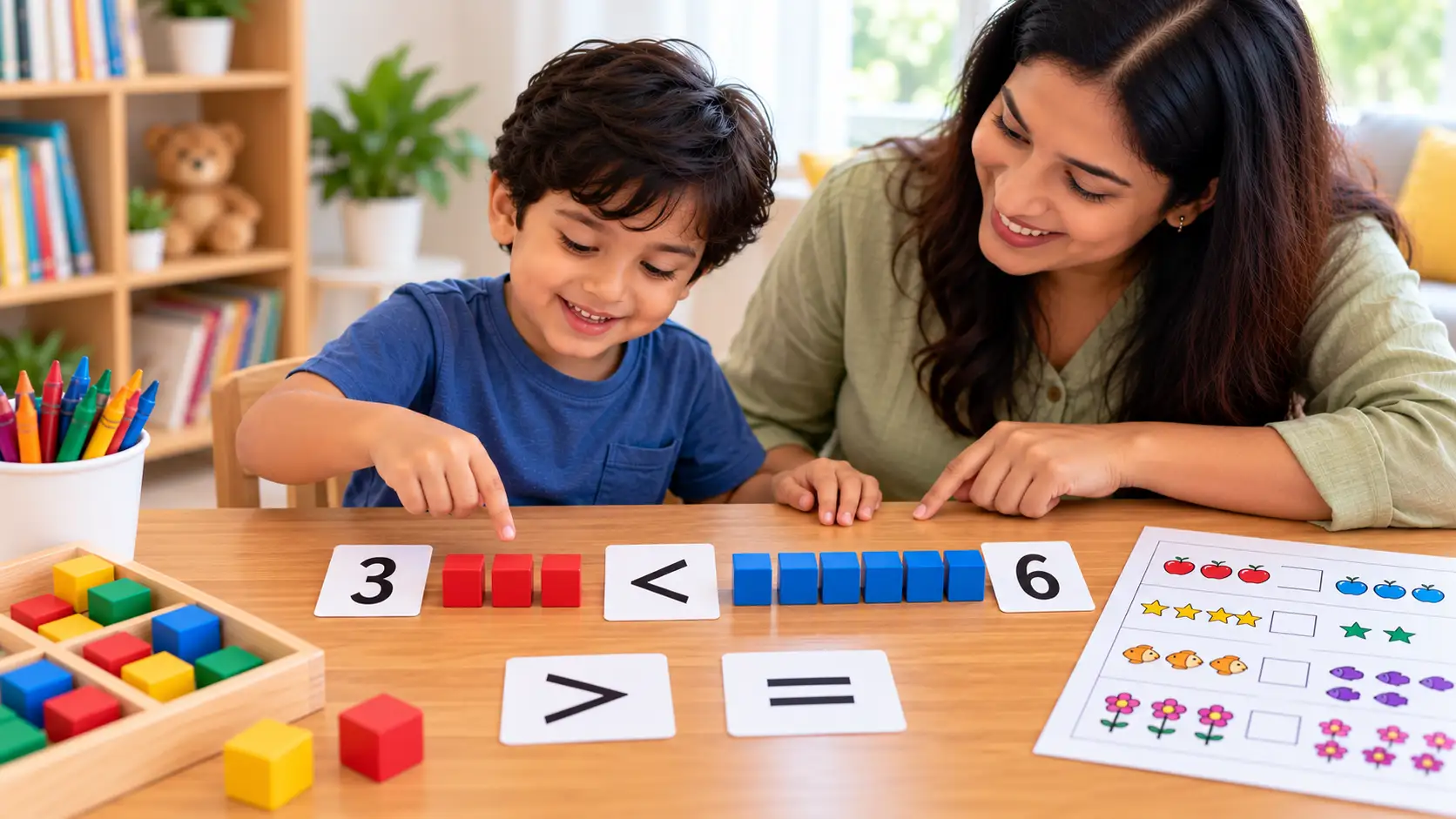
Is your child learning to compare numbers? Understanding which number is bigger or smaller is an important step in early maths. For kindergarten children, concepts such as greater than and less than can feel confusing at first, especially when they are introduced through symbols alone.
The easiest way to begin is with objects children can see, touch and count. A group of five blocks compared with a group of two blocks makes the idea of more and fewer much easier to understand.
With a few simple games and everyday materials, you can help your child explore number comparisons in a fun, hands-on way.
In this guide, we'll share 12 greater than and less than activities for kindergarten kids, along with practical tips to help children compare quantities, understand mathematical symbols and build confidence with early maths.
What Do Greater Than and Less Than Mean?
Greater than and less than are mathematical concepts that help children compare two numbers or quantities.
-
Greater than (>): One number is bigger than another number.
-
Less than (<): One number is smaller than another number.
-
Equal to (=): Two numbers or quantities are the same.
For example:
-
5 > 2 means five is greater than two.
-
3 < 7 means three is less than seven.
-
4 = 4 means both numbers are equal.
Before introducing these symbols, let your child compare groups of objects. Once they understand which group has more or fewer items, it becomes easier to connect that idea with written numbers.
Why Should Kindergarten Kids Learn Number Comparison?
Comparing numbers helps children develop the foundation for more advanced mathematical concepts.
1. Builds number sense
Children begin to understand that numbers represent quantities and that some quantities are larger or smaller than others.
2. Improves counting skills
Comparing two groups encourages children to count carefully and check how many objects each group contains.
3. Introduces mathematical symbols
Hands-on activities help children understand what >, < and = represent before using them in written exercises.
4. Prepares children for addition and subtraction
Understanding how quantities compare supports later learning about adding, taking away and finding differences between numbers.
5. Develops logical thinking
Children learn to observe, compare and explain why one group has more objects than another.
12 Fun Greater Than and Less Than Activities for Kindergarten Kids
These activities begin with concrete objects and gradually introduce number comparisons and mathematical symbols. Start with small numbers and increase the difficulty when your child is ready.
1. Compare Two Groups of Building Blocks
Building blocks are a simple way to introduce greater than and less than.
What you need: Building blocks in two different colours.
How to play:
-
Make one group with three blocks and another with five.
-
Ask your child to count the blocks in each group.
-
Ask which group has more blocks and which has fewer.
-
Repeat with different quantities.
For example, place four red blocks beside two blue blocks. Explain that four is greater than two because the red group contains more blocks.
Once your child understands the comparison, introduce the matching number sentence: 4 > 2.
Learning benefit: Helps children connect quantities with number comparisons.
2. Play the Greater Than, Less Than Card Game
Number cards help children compare written numbers without always needing physical objects.
What you need: Number cards from 1 to 10.
How to play:
-
Pick two number cards and place them side by side.
-
Ask your child to identify the larger number.
-
Ask which number is smaller.
-
Let your child explain how they know.
For example, if the cards show 3 and 8, your child should identify 8 as greater than 3.
For an extra challenge, let your child choose the cards and explain the comparison to you.
Learning benefit: Strengthens number recognition and comparison skills.
3. Compare Toy Collections
Use your child's favourite toys to make comparison activities more interesting.
Place four toy cars on one side of the table and two toy animals on the other.
Ask questions such as:
-
Which group has more toys?
-
Which group has fewer toys?
-
How many cars are there?
-
How many animals are there?
After counting, explain that four is greater than two.
You can also make both groups equal and introduce the idea that neither group has more or fewer objects.
Learning benefit: Introduces comparison through familiar objects and everyday play.
4. Use the Alligator Mouth Trick
Many children find it easier to remember greater than and less than symbols when they associate them with an alligator's open mouth.
Explain that the open side of the symbol faces the greater number, while the pointed end faces the smaller number.
For example:
-
7 > 4: The open side faces 7.
-
2 < 6: The open side faces 6.
Draw a friendly alligator around the symbol and let your child decorate it.
Keep the explanation simple and always connect the symbol to the actual numbers being compared. The alligator is a memory aid, not a substitute for understanding quantities.
Learning benefit: Makes mathematical symbols more memorable for young learners.
5. Compare Snacks or Fruit Pieces
Snack time can become an opportunity to practise comparing quantities.
Place three apple slices on one plate and five on another, using age-appropriate portions.
Ask your child to count the pieces on each plate and identify which plate has more.
Then introduce a number comparison: 3 < 5.
You can also give both plates the same number of pieces to demonstrate equality.
Always supervise your child during meals and use foods prepared safely for their age.
Learning benefit: Connects mathematical comparisons with everyday experiences.
6. Play a Number Line Game
A number line helps children understand the order of numbers.
What you need: A number line from 1 to 10, printed or drawn on paper.
Point to two numbers and ask your child which one is greater.
For example, compare 3 and 7. Show your child that 7 appears farther to the right on the number line.
Then compare 8 and 5. Explain that 8 is greater because it appears farther to the right.
Once your child is comfortable, ask them to find the smaller number without counting from the beginning every time.
Learning benefit: Builds understanding of number order and relative size.
7. Sort Objects into More and Fewer Groups
Sorting helps children compare quantities visually.
Gather large blocks, toy animals or other safe objects and divide them into two groups.
Ask your child to arrange the groups so one contains more objects and the other contains fewer.
Next, count the objects and describe the comparison.
For example, a group of six blocks has more objects than a group of four blocks.
You can change the groups and ask your child to find a new example.
Learning benefit: Encourages visual comparison, counting and reasoning.
8. Use Number Cards with Comparison Symbols
Once your child understands greater than and less than using objects, introduce the symbols directly.
What you need: Number cards and separate cards showing >, < and =.
Place two numbers on the table with a space between them. Ask your child to select the correct symbol.
For example:
-
6 __ 2
-
3 __ 8
-
5 __ 5
Help your child complete each comparison:
-
6 > 2
-
3 < 8
-
5 = 5
Start with small numbers and provide guidance whenever needed.
Learning benefit: Connects quantity comparison with written mathematical expressions.
9. Play a Greater Than and Less Than Movement Game
Add movement to number practice with a simple game.
Write numbers on separate sheets of paper and place them on the floor.
Call out two numbers, such as 4 and 9. Ask your child to move to the larger number, then find the smaller one.
You can also hold up two number cards and ask your child to show a thumbs-up when the first number is greater than the second.
Keep the activity playful and adjust the number range to your child's ability.
Learning benefit: Reinforces number comparisons through movement and repetition.
10. Make Number Towers
Use blocks to build towers of different heights.
Build one tower with two blocks and another with six blocks. Ask your child which tower is taller.
Count the blocks in both towers and write the comparison as 2 < 6.
Then change the quantities and let your child build their own towers.
For an additional challenge, ask them to make two towers with the same number of blocks.
Learning benefit: Turns abstract comparisons into something children can see and touch.
11. Compare Numbers in Everyday Situations
Children can practise comparing quantities throughout the day.
Try simple questions while tidying up, playing or preparing for an activity:
-
Are there more pencils or crayons?
-
Do you have fewer books than toys?
-
Which plate has more pieces of fruit?
-
Are there more red blocks or blue blocks?
Encourage your child to count the objects before answering when the quantities are not immediately obvious.
As their skills improve, ask them to express the comparison using numbers and symbols.
Learning benefit: Helps children apply mathematical thinking outside structured lessons.
12. Practise with Printable Greater Than and Less Than Worksheets
After exploring comparisons through games, printable worksheets can help children practise independently.
Choose worksheets that progress from simple visual comparisons to written number sentences.
Useful activities include:
-
Compare quantities: Count pictures and identify which group has more objects.
-
Circle the greater number: Choose the larger number from two options.
-
Circle the smaller number: Identify the number with the lower value.
-
Fill in the missing symbol: Complete number sentences using >, < or =.
-
Match numbers and quantities: Connect numerals with groups of objects.
-
Colour the correct answer: Complete simple comparison exercises using pictures.
For beginners, start with quantities up to five. As children become more confident, introduce comparisons up to 10 and then larger numbers.
Explore Kids Easy Learning for printable learning resources and choose appropriate maths worksheets to support your child's practice.
You can also pair worksheets with a hands-on comparison game. Let your child build two groups of blocks first, then complete a worksheet showing the same type of comparison.
How to Teach Greater Than and Less Than Step by Step
If your child is new to number comparison, introduce the concept gradually rather than starting with symbols.
Step 1: Compare real objects.
Show your child two groups and ask which has more objects. Begin with noticeably different quantities, such as two and five.
Step 2: Count each group.
Help your child count the objects accurately and identify the total in each group.
Step 3: Compare the written numbers.
Show the matching numerals and explain which number represents the larger quantity.
Step 4: Introduce the symbols.
Explain that > means greater than and < means less than. Use examples that match the objects your child has already counted.
Step 5: Practise with simple number sentences.
Try examples such as 4 > 2, 3 < 6 and 5 = 5.
Step 6: Reinforce learning through games.
Use number cards, building blocks, movement games and printable worksheets to practise the same concept in different ways.
Children may need repeated practice before they consistently remember which direction each symbol faces. Be patient and return to objects whenever the symbols become confusing.
Common Mistakes to Avoid When Teaching Number Comparisons
A few simple adjustments can help children understand greater than and less than more clearly.
Introducing symbols too early: Children may memorise > and < without understanding what they mean. Start with real objects and quantities.
Focusing only on the alligator trick: The alligator can help children remember the symbol, but they should also understand which number is larger.
Using numbers that are too difficult: Begin with small quantities and familiar numbers before introducing larger comparisons.
Forgetting equal quantities: Children should also learn that two groups can contain the same number of objects.
Correcting mistakes too quickly: Ask your child to count both groups again and explain their thinking before giving the answer.
Rushing through worksheets: Prioritise understanding over the number of questions completed.
Frequently Asked Questions
Start by comparing two groups of objects. Help your child count each group and identify which has more or fewer items. Once they understand the idea, introduce the symbols > and < using simple number examples.
Explain that the open side of the symbol faces the greater number and the pointed end faces the smaller number. The alligator-mouth trick can help children remember the direction, especially when paired with hands-on examples.
Greater than means a number has a higher value than another number. Less than means it has a lower value. For example, 8 > 3 means eight is greater than three, while 2 < 5 means two is less than five.
Children can begin comparing groups of objects during the preschool years. Formal practice with written comparison symbols is often introduced around kindergarten, depending on the child's readiness and learning environment.
Use building blocks, toys, number cards, snacks and simple number-line games. Ask your child to compare two groups, count the objects and identify the greater or smaller number. Printable worksheets can provide additional practice.
Yes. Age-appropriate worksheets can reinforce number comparisons, symbol recognition and quantity understanding. They are most effective when children have first explored the concepts through physical objects and interactive games.
Make Number Comparisons Fun with Kids Easy Learning
Learning greater than and less than becomes easier when children can see the difference between two quantities. Start with toys, blocks and everyday objects, then gradually introduce number cards, symbols and worksheets.
Keep activities short, encourage your child to explain their answers and revisit the concept through different games. With regular practice, children can develop a stronger understanding of number comparisons and build confidence in early maths.
Explore Kids Easy Learning for printable learning resources that make maths practice engaging for preschool and kindergarten children.